
Last updated: November 19, 2026
Quick Answer: crypto market insights are usually about liquidity, sentiment, network activity, and rules — not magic price predictors. This page covers Crypto Market Insights: A Deep Look at Digital Currencies: related questions in plain language, with a focus on the questions people ask most often. Crypto moves fast, but the questions people ask are usually simple: what drives the market, why do prices swing so hard, and how do you read signals without getting fooled. Crypto market insights are mostly about liquidity, sentiment, network activity, and rules — not magic price predictors. This post sorts the common questions into plain answers, and it stays in information-only mode; for your own situation, a qualified adviser can help.
Key Takeaways
- Crypto prices often move on liquidity, headlines, and flows, not on one clean valuation formula.
- Big coins and smaller tokens can react very differently to the same news.
- On-chain data can help, but it can also mislead if you ignore exchange activity and macro conditions.
- Regulation, taxes, and custody rules vary by country and change over time.
- A useful question set is often about risk, time frame, and use case, not “which coin wins?”
What actually drives crypto prices?
Crypto prices are mostly driven by buyers, sellers, and the speed of money moving through the market. That sounds plain, but it explains more than most “expert” takes, because digital assets trade 24/7 and can react in minutes to news, funding stress, or a sudden jump in demand.
For example, you’re watching a coin rise on a weekend when traditional markets are closed. The move may have little to do with fundamentals and a lot to do with thin liquidity, forced buying, or traders piling into the same story. That matters because a sharp move in a small market can reverse fast.
Here’s the catch: not every price move means the same thing. A rise on high trading volume and broad participation is different from a jump caused by one exchange, one whale, or one viral post. The first can reflect real market interest. The second can disappear just as fast.
What to watch:
- Liquidity: Thin markets can move hard on small orders.
- Volume: Rising volume can confirm interest, but volume can also be wash trading on weak venues.
- Market structure: Perpetual futures, leverage, and liquidations can amplify moves.
- Narrative: ETF news, protocol upgrades, and macro headlines often matter more than people admit.
Specifically, if a price move comes with no clear shift in volume, exchange inflows, or broader sentiment, treat it as fragile. That is not a forecast. It is just a warning label, and if you are making a major financial decision, consult a qualified professional and check a source such as the U.S. Securities and Exchange Commission’s investor guidance on crypto assets: https://www.sec.gov/investor.
How do you read crypto market sentiment without getting fooled?
You read crypto sentiment by checking whether the market is agreeing across price, volume, funding, and social chatter — not by trusting any single signal. A green chart does not always mean bullish conviction, and a loud social feed does not always mean real demand.
For instance, you open a chart, see a burst of posts, and assume the crowd knows something. Sometimes it does. Other times the crowd is late, overconfident, or reacting to the same headline you already saw. Sentiment matters, but it is easy to over-read.
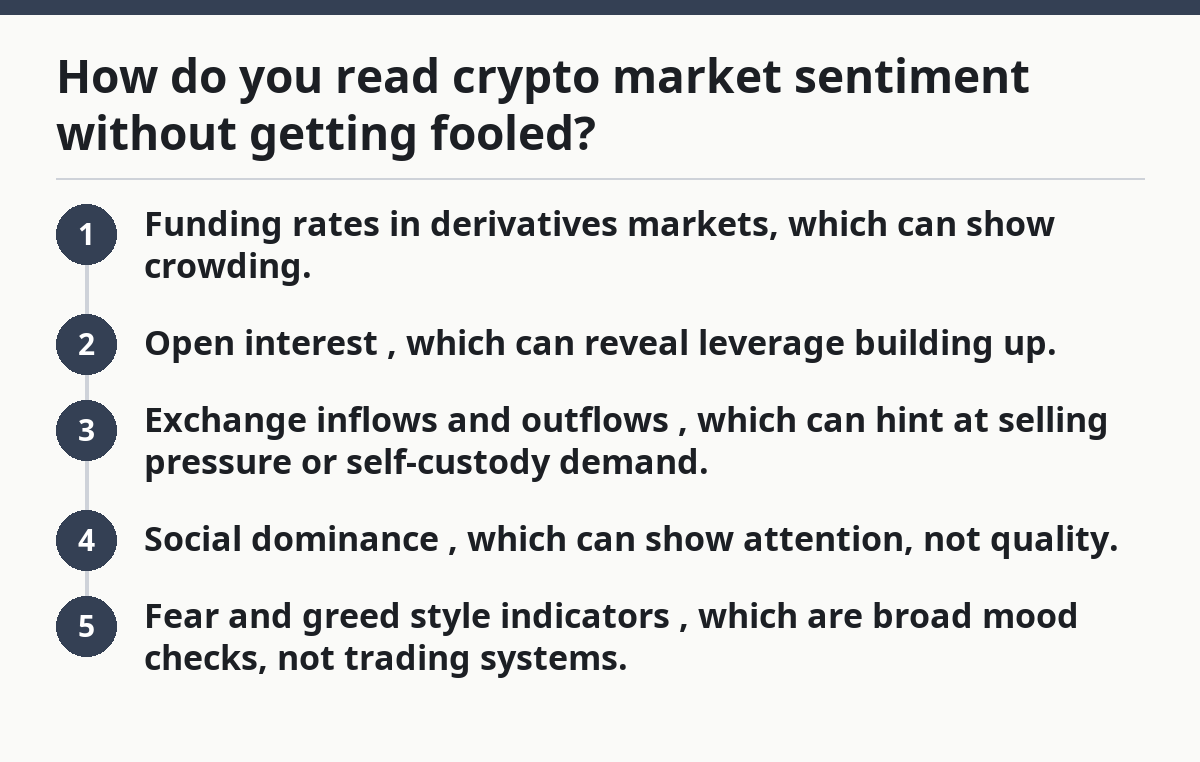
The most useful signals are usually these:
- Funding rates in derivatives markets, which can show crowding.
- Open interest, which can reveal leverage building up.
- Exchange inflows and outflows, which can hint at selling pressure or self-custody demand.
- Social dominance, which can show attention, not quality.
- Fear and greed style indicators, which are broad mood checks, not trading systems.
Be careful with any indicator that looks too neat. Crypto markets love false confidence because they are open all day, every day, and the crowd can chase the same trade at the same time. A sentiment spike can mark a breakout. It can also mark the top.
Ultimately, sentiment tools are most useful when they disagree with price. If a coin is rising while funding stays calm, the move may be cleaner than one driven by levered longs. If everyone is euphoric and leverage is stacked, the market may already be crowded.
What do on-chain metrics really tell you?
On-chain metrics can tell you where coins are moving, but they do not tell you price direction on their own. They are a map of activity, not a promise of profit, and that distinction saves people from a lot of bad conclusions.
Because on-chain data can look persuasive, you may see wallet growth, rising active addresses, and a token dashboard glowing green. That can look like adoption. It can also reflect one exchange moving funds, one airdrop campaign, or many small wallets splitting balances. The chain shows motion. It does not explain motive by itself.
A few metrics deserve attention:
- Active addresses: useful, but noisy.
- Transaction count: can rise for many reasons, including spam.
- Exchange balances: often watched as a rough supply clue.
- Realized value and cost basis metrics: more advanced, and better for context than for timing.
- Stablecoin flows: important because they can hint at dry powder or de-risking.
Do not treat these numbers as a forecasting machine. A network can look healthier on-chain while the token price still falls. Why? Because price also depends on demand, listings, macro conditions, and trust in the asset itself; if you are making a decision with material financial consequences, consult a professional and check a source such as Chainalysis research or exchange methodology notes.
If you want one clean question, ask this: is capital leaving exchanges faster than it is entering them, and is that happening while price holds up? That is more informative than any single dashboard tile. Still, it is a clue, not a verdict.
How do crypto, stocks, and bonds differ in a portfolio?
Crypto behaves more like a high-volatility risk asset than like cash or a bond, and that changes how it fits into a portfolio. It can rise when risk appetite is strong and fall hard when traders want safety, which means its role is usually different from assets that pay income or have clearer business cash flow.
For context, you can compare a token to a share of a profitable company and wonder why the token seems harder to value. That’s because many digital assets do not have earnings, dividends, or a standard valuation anchor. Some are used in networks, some are speculation vehicles, and some are closer to software infrastructure. They are not one category in practice, even if the market calls them all “crypto.”
The main differences:
- Stocks can be tied to earnings, margins, and business growth.
- Bonds are linked to repayment terms and interest rates.
- Crypto often depends on adoption, scarcity design, network use, and market belief.
That does not make crypto “bad” or “good.” It makes it different. The danger is comparing it to the wrong benchmark. If you expect bond-like stability, you will be disappointed. If you expect stock-like analysis, you may miss token economics, validator incentives, or governance risk.
The truth is, the portfolio question is usually about correlation and drawdown, not ideology. If an asset can fall 30% while nothing in your personal finances changes, it should be treated as speculative exposure, not a core safety asset. That is a description, not advice, and for personal portfolio decisions you should consult a qualified adviser and review a credible source such as the Financial Conduct Authority’s crypto warnings: https://www.fca.org.uk.
Which crypto questions matter most before you act?
The most important questions are about purpose, time frame, and loss tolerance, because those three decide whether the rest of the market data matters at all. A person trading for a week needs different signals than a person learning how a network works.
Because of that, you are about to click into a trade or a wallet transfer, and the chart looks exciting. The right move is to pause and ask what problem the asset is supposed to solve for you. If that answer is fuzzy, every metric after it is noise.
Ask these questions first:
- What is this asset for? Payment, governance, speculation, or network utility.
- What has to be true for it to work? User growth, developer activity, stable rules, or continued exchange access.
- What can break the thesis? Regulation, hacks, dilution, poor liquidity, or loss of trust.
- How easy is it to exit? Liquidity matters more than many beginners think.
- What jurisdiction rules apply? Tax treatment, reporting, and access differ by country.
A generic post often skips the unglamorous part: fees, taxes, custody, and recordkeeping. That omission is costly. A token can look attractive on a chart and still be a poor fit once you include spreads, transfer fees, or local reporting rules. Rates, thresholds, and tax treatment vary by country and change often, so local guidance matters.
For broader context, the U.S. Securities and Exchange Commission and the Financial Conduct Authority both publish plain-language investor warnings about crypto risk; the exact page you need depends on your country and the issue you are checking. That is the sort of source that helps when headlines get loud.
The real difference between market data and market noise
Market data tells you what is happening; market noise tells you what people want you to believe is happening. The two are easy to mix up because crypto has plenty of charts, dashboards, and hot takes, but not all signals deserve the same weight.
Since one dashboard may say “accumulation,” another may say “distribution,” and a third may say “bullish divergence,” you can talk yourself into almost anything. The market does not care about your screen count. It cares about supply, demand, and trust.
Use this simple filter:
- Can the data be verified? Prefer exchange data, blockchain records, and named methodology.
- Does the signal repeat? One day is a headline; several weeks can be a trend.
- Does it match the market structure? A signal that ignores leverage or liquidity is weak.
- Is there a reason for the move? News, policy, protocol changes, or macro pressure.
A generic crypto post often treats “market insight” as if it means prediction. It does not. Real insight often means knowing which questions are too early to answer, and which numbers are too noisy to trust. That judgment is more useful than a flashy forecast.
When should you be extra cautious with crypto market insights?
You should be extra cautious when the move is fast, the headline is loud, and the signal comes from only one source. That is the classic setup for overreaction, especially in markets that trade around the clock.
For example, a token spikes after one exchange listing rumor, one influencer post, or one regulatory comment. The chart may keep moving for a while, but the first job is not excitement — it is source checking. If the claim is hard to verify, the trade thesis is soft.
Be careful in these cases:
- Low-liquidity tokens with wide spreads.
- Leveraged markets where liquidations can cascade.
- Regulatory headlines that may affect only one country.
- Tax or reporting claims posted without local context.
- Promises of “safe” yield tied to opaque mechanisms.
One more point: never assume a data dashboard is neutral. Different platforms can use different exchange sets, time windows, or wallet labels. A figure without methodology is just decoration. If the page does not explain how the number was built, treat it as a starting point, not a conclusion.
FAQ: related questions people ask about crypto market insights
What is the most important signal in crypto market analysis?
The most important signal is usually liquidity. Price can move on attention, but sustained moves need buyers, sellers, and enough depth for the market to absorb trades without snapping back immediately.
Can on-chain data predict price?
On-chain data can help explain what holders and wallets are doing, but it does not reliably predict price by itself. It works best as context alongside volume, sentiment, derivatives activity, and macro conditions.
Why do crypto prices move when stocks are closed?
Crypto trades 24/7, so it reacts to news when traditional markets are shut. Thin weekend or overnight liquidity can make the move sharper than what you would see in stocks.
Are crypto market insights the same in every country?
No. Tax rules, exchange access, custody rules, and reporting standards vary by country and can change. Local rules matter as much as market data when you are trying to understand the real cost and risk.
What should a beginner focus on first?
A beginner should focus on what the asset does, what can go wrong, and how liquid it is. Those three questions cut through most hype and are easier to verify than price predictions.
Drafted with AI; not yet reviewed by a person.