Last updated: November 19, 2026
Key Takeaways
- A seed phrase lets one backup recover an entire wallet.
- It determines the wallet’s private keys, which control spendable blockchain addresses.
- The phrase becomes a seed, then deterministic keys the wallet can reuse.
- Private keys are the signing secrets; the seed phrase can regenerate them.
A wallet with 12 or 24 words is not giving you a password prompt; it is handing you the recovery root. Why a seed phrase exists and what it controls is the recovery root that can recreate your wallet and all of the private keys it controls. In BIP39-based wallets, that usually means 12 or 24 words.
What follows clears up the mechanics, the limits, and why wallet software still leans on a 12-word or 24-word phrase.
Why a seed phrase exists at all
One backup has to do a lot of work. Picture a crypto wallet on a phone, then imagine that phone breaks, gets wiped, or vanishes; without a seed phrase, the wallet’s keys are simply gone with it.
So the phrase exists as a human-readable stand-in for the secret math underneath. Most wallets follow the BIP39 standard and use 12 or 24 words for that backup. Those words are not the money; they are the recovery data that can restore the wallet’s key structure.
- The wallet stores keys, not coins.
- The seed phrase recreates the keys.
- The coins stay on the blockchain.
And here’s the part people miss: a seed phrase is not a password you type into a website. It is a master recovery secret. If someone gets it, they can restore the same wallet elsewhere and control the assets tied to it. That is the whole point — one compact backup instead of a pile of separate private keys.
A generic explanation usually stops at convenience, which is too neat. The real reason is deterministic design: modern wallets can start from one secret and generate a long chain of keys in a repeatable way. That makes backup possible without writing down every address or every private key.
What does a seed phrase control?
A seed phrase controls the wallet’s private keys, and those keys control the blockchain addresses the wallet can spend from. Install the same wallet app on a new device, enter the same 12 words, and the app reconstructs the same key tree and the same addresses. The result is access to the same wallet identity, not a fresh one.
That control is broad, but it is not magic. A seed phrase does not move coins by itself. It does not send a transaction. It does not alter the blockchain. What it does is give the wallet the ability to derive the private keys needed to sign transactions.
- Seed phrase = master recovery secret
- Private key = secret used to sign
- Public address = place where funds can be received
Because the private keys are derived from it, the phrase sits upstream of them. In BIP39-based wallets, the phrase maps into a seed, and that seed feeds the wallet’s key generation process. That is why one phrase can restore many accounts and many addresses inside the same wallet structure.
If a wallet supports multiple coins or chains, the same phrase may also rebuild several of those views, depending on the wallet’s design and derivation paths.
- One phrase can cover many keys.
- Those keys can cover many addresses.
- The wallet app is only the tool that reads them.
How a seed phrase turns into a wallet
Enter the same 24 words into two wallet apps that support the same standard, and both can rebuild the same underlying wallet structure. Why? Because the conversion is deterministic. First the words become a seed, then the seed becomes deterministic keys the wallet can use again and again.
The chain looks like this:
- You record a BIP39 seed phrase, usually 12 or 24 words.
- The wallet converts those words into a seed.
- The wallet uses that seed with a derivation path to create private keys.
- Those private keys produce public addresses.
- The wallet shows the balances linked to those addresses.
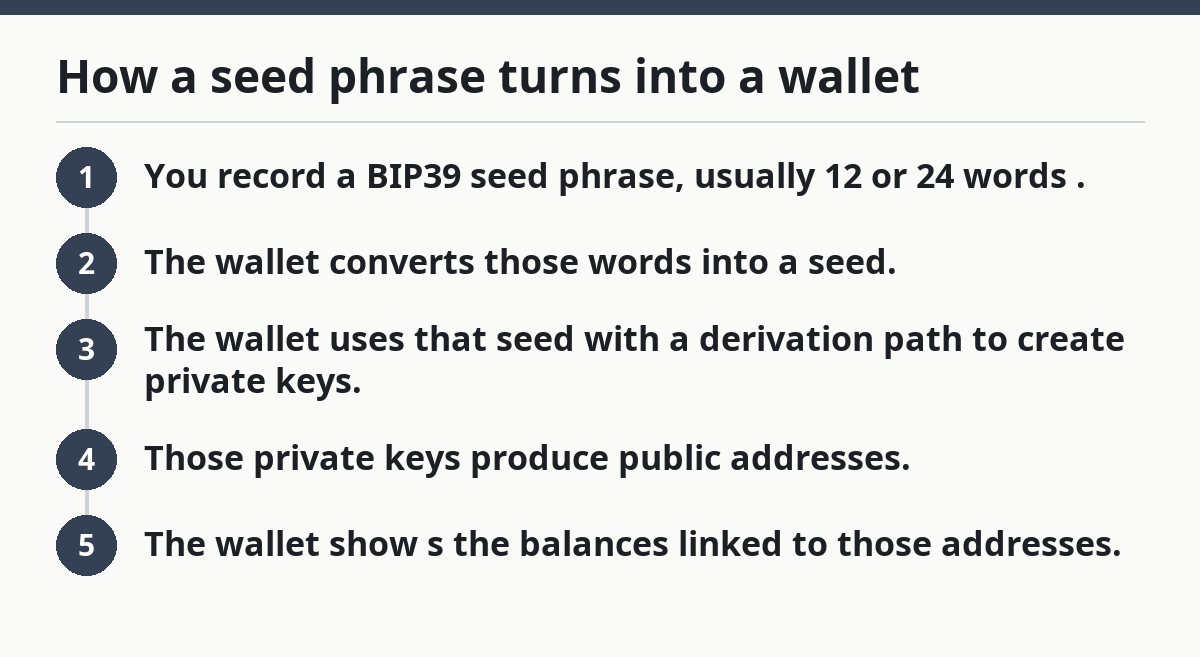
That means you can recover the wallet on another device without the original phone or laptop. Same words, same root material, same keys — as long as the wallet follows the same standard and derivation path.
But the last clause matters. Two wallets can both support BIP39 and still show different accounts if they use different derivation paths or coin support. The seed phrase is the starting point, not the whole map. The map depends on the wallet’s rules.
A common mistake is treating the phrase like a username. Safer approach: treat it as a recovery secret; if you are unsure how your wallet handles it, consult the wallet’s documentation or a qualified professional. A username identifies an account on a service. A seed phrase generates the account structure itself. That difference is why the phrase needs careful handling and why wallet software warns so strongly about it.
- Standard used: BIP39
- Common phrase length: 12 words or 24 words
- Result: the same wallet structure can be rebuilt
Why private keys matter more than the phrase on its own
Private keys matter because they are the direct signing secrets, while the seed phrase is the master source that can recreate them. Need to approve a transfer? The network does not care about your seed phrase. It cares about the signature made by the private key for the address that holds the funds.
So the seed phrase sits one layer above the action. It is the root backup. The private key is the working secret. Looking only at the phrase can make it feel abstract; look at the private key and the purpose snaps into focus — that key proves control.
This is also why the phrase is so sensitive. Anyone who knows it can derive the same private keys and act as the wallet owner. If you are unsure who should have access, consult the wallet provider or a qualified professional before sharing it. The blockchain has no separate “forgot password” button for that. The network accepts valid signatures.
The practical difference is simple:
- The seed phrase restores the wallet.
- The private key authorizes spending.
- The address receives funds and shows balances.
You do not need to understand every line of cryptography to use the wallet safely. You do need to know that the seed phrase is not the thing you spend with. It is the thing that can recreate the thing you spend with.
What a seed phrase does not control
A seed phrase does not control the blockchain itself, the price of a coin, or the funds in someone else’s wallet. Picture this: you have the seed phrase for one wallet, but not for a different one. That phrase gives you no power over the other wallet’s assets, even if the addresses look similar.
Nor does it rewrite what is already on-chain. If a transaction was sent, the seed phrase cannot reverse the network. If a token was minted elsewhere, the phrase cannot alter that record. It only restores the wallet that generated the keys.
That is where people can make expensive assumptions. They think a seed phrase is a universal master key for all crypto. It is not. It is master-level only within the wallet structure derived from that phrase. Different phrase, different wallet. Different derivation path, sometimes different visible accounts. Different network, often different address format.
A few limits to keep straight:
- It does not recover a forgotten exchange login.
- It does not give access to a wallet created from a different phrase.
- It does not fix a transaction already confirmed on-chain.
The truth is, the phrase is powerful but narrow. It controls the wallet it created, and nothing beyond that. That narrowness is what makes the model workable. One secret can restore a whole wallet, but it cannot reach into every other wallet on the internet.
Why wallet design uses BIP39 and deterministic wallets
BIP39 and deterministic wallets exist because people need a backup system that is both machine-readable and human-copyable. Picture this: a wallet has to generate many private keys over time, yet the user should only need to save one recovery secret. That is the design goal BIP39 helps meet.
BIP39 gives wallets a standard way to turn words into a seed. Deterministic wallets then use that seed to generate keys in a repeatable sequence. Backup gets easier than storing a pile of separate private keys, one for each address or account.
There are trade-offs. A single seed phrase is easier to manage, but it also creates a single point of failure. Lose it, and the wallet can become unrecoverable. Expose it, and the wallet can be taken over. That is the cost of putting the whole recovery root in one place.
- BIP39 standardizes the phrase format.
- Deterministic wallets rebuild keys from one root.
- The benefit is simple recovery.
- The risk is concentrated control.
That trade-off is the real reason seed phrases exist. Without them, every wallet would need its own separate secret for every address, and recovery would be a mess. With them, one backup can reconstruct the whole key tree. Elegant? Yes. Fragile? Also yes, because everything rests on one line of words.
What beginners usually misunderstand about seed phrases
A seed phrase is often mistaken for the coins, the address, or a login. Picture this: you see a 12-word phrase on screen and think it is just a setup step. It is more serious than that. It is the root of the wallet’s control layer.
The most common mistake is thinking the phrase can be shared with support staff or typed into any website that claims to help. That turns a recovery secret into a theft tool. If you are unsure whether a request is legitimate, contact the wallet provider directly before entering the phrase anywhere. Another mistake is assuming one phrase only covers one visible account. In many wallets, it can cover several derived accounts and addresses.
Some quick corrections:
- The phrase is not a public identifier.
- It is not a password reset code.
- It is not the asset itself.
- It is the source from which control is rebuilt.
On the flip side, people sometimes overstate the phrase and treat it as if it can do everything. It cannot reverse transfers, and it does not override network rules. It simply lets compatible wallet software regenerate the private keys tied to that phrase.
If you want the clean mental model, use this: the seed phrase is the master recovery root, the private key is the spend secret, and the wallet app is the interface that translates that secret into usable accounts.
Why do I need a seed phrase?
You need a seed phrase because without it, a non-custodial wallet has no built-in recovery path. Picture this: your device fails, and the wallet app is gone. If the wallet was built from a seed phrase, you can recreate the keys on a new device. If it was not, the wallet may be unrecoverable.
That is the main reason it exists. It gives the user a portable recovery root instead of forcing the wallet to depend on a single device. For BIP39-based wallets, the phrase is the bridge between one installation and the next.
The downside is obvious. The same thing that makes recovery possible also makes theft possible if the phrase leaks. So the phrase exists because wallet ownership in crypto is direct. No bank can reset it for you. No central service can always step in. The wallet needs a self-contained way to rebuild access.
The seed phrase is the answer to that problem.
What does a seed phrase open?
A seed phrase opens the wallet’s private keys, and those keys open the ability to sign transactions. It does not open the blockchain as a whole, and it does not give access to other wallets that were built from different words. In a BIP39 wallet, the phrase is the recovery root for the keys tied to that wallet.
Is a seed phrase the same as a private key?
A seed phrase is not the same as a private key. The seed phrase is the master recovery secret, while a private key is one specific signing secret derived from it. One phrase can create many private keys, which is why the phrase can restore more than one address or account in a deterministic wallet.
Why do I need a seed phrase?
You need a seed phrase because it lets you recover a wallet without the original device. A deterministic wallet can rebuild the same key structure from the same 12 or 24 words, which makes backup possible. Without that recovery root, losing the device can mean losing access to the wallet entirely.
Drafted with AI; not yet reviewed by a person.