Last updated: November 19, 2026
Quick Answer: Bitcoin Basics and Ownership: The Complete Guide is about one core rule: control of the private keys usually determines control of the bitcoin. For many readers, the practical choice is between convenience on an exchange and direct control in self-custody.
Key Takeaways
- Bitcoin is a public payment network and an asset, not a company, not a stock, and not a physical coin you own in the ordinary sense.
- Bitcoin ownership means control over the private keys that can spend the coins, not a name on a paper title.
- Exchange accounts are convenient; self-custody gives direct control.
- A Bitcoin wallet stores the keys or key material needed to spend coins, not the coins themselves.
Bitcoin is digital money you can send without a bank, and ownership means controlling the private keys that can move those coins. If you do not control the keys, you do not truly control the bitcoin.
In short: Bitcoin is not stored in a file on your laptop, and it is not “kept” by the exchange in the way cash sits in a bank vault. What matters is which keys can sign a transaction on the blockchain. The rest of this guide explains how bitcoin works, what ownership really means, and how to avoid the mistakes that cost beginners their coins.
I write about bitcoin and custody because the topic sits at the intersection of finance, software, and basic security, and beginners are often given advice that skips the one thing that matters most: who can sign.
What Bitcoin actually is
Bitcoin is a public payment network and an asset, not a company, not a stock, and not a physical coin you own in the ordinary sense. The network records transfers on a blockchain, which is a shared ledger maintained by nodes; the asset itself is a balance associated with a cryptographic key pair.
Here is the simplest useful mental model: a bitcoin address is like an account number, while the private key is like the only key that can open and move the balance linked to that address. If someone else gets the private key, they can spend the coins. If you lose it, the network will not reset it for you.
That is the part many beginner articles leave out. “Owning bitcoin” is not a vague claim of entitlement. It is the practical ability to authorize a transaction with a valid signature. The protocol does not care who you are, where you live, or whether you have a receipt. It cares whether the signature checks out.
Bitcoin uses a fixed supply schedule, with new coins issued as block rewards to miners on a roughly ten-minute block interval, though individual blocks arrive faster or slower in real time. That issuance schedule is encoded in the protocol, which is one reason people treat bitcoin differently from ordinary app-based money. For a protocol-level reference, the Bitcoin Developer Guide from bitcoin.org and the Bitcoin white paper are the foundational documents; if you are making custody decisions for a large amount, consult a qualified professional and review the source material directly.
A useful source on the technical side is the Bitcoin white paper by Satoshi Nakamoto and the Bitcoin.org developer documentation on transactions and keys:
- Bitcoin white paper: https://bitcoin.org/bitcoin.pdf
- Bitcoin Developer Guide: https://developer.bitcoin.org/devguide/
For a second authoritative reference, the SEC’s investor bulletin on crypto assets explains custody and risk in plain terms:
- SEC Investor Bulletin: Crypto Asset Investing: https://www.investor.gov/introduction-investing/investing-basics/glossary/crypto-asset-investing
How bitcoin ownership really works
Bitcoin ownership means control over the private keys that can spend the coins, not a name on a paper title. That distinction matters because two people can both believe they “own” the same bitcoin, but only one can actually move it on-chain at any given moment.
A beginner often buys bitcoin on an exchange and assumes the coins are immediately “theirs” in the same way a share is theirs in a brokerage account. In practice, that depends on custody. If the exchange holds the keys, the exchange controls the spend. You may have a claim against the platform, but you do not have direct on-chain control until the coins are withdrawn to a key you control.
There are three common ownership states:
- Exchange custody — The platform controls the keys. This is convenient and familiar, but it introduces counterparty risk. If the platform freezes withdrawals, goes bankrupt, or suffers a security incident, your access can be delayed or lost.
- Self-custody — You control the private keys yourself, usually through a software or hardware wallet. This gives you direct control, but the burden shifts to you: backup, recovery, and transaction verification.
- Shared or institutional custody — A custodian, company, or multisignature setup controls the keys under a defined policy. This can reduce single-point failure, but it adds process and dependence on third parties.
The key question is not always “Do I own bitcoin?”; it is often “Who can sign the transaction right now?” That is the question that matters when a transfer has to happen.
A lot of confusion comes from language. An exchange may show “your bitcoin balance,” and a lender may show “your bitcoin account,” but those are accounting labels, not proof of direct control. The blockchain does not recognize labels. It recognizes signatures.
If you want a plain-English rule, use this: if you cannot export, back up, or independently verify the private key material behind your bitcoin, then you do not have full ownership in the practical sense people usually mean.
The real difference between an exchange account and self-custody
An exchange account wins for convenience; self-custody wins for control. The right choice depends on whether your bigger risk is making a mistake yourself or trusting a third party with your coins, and if you are unsure, a financial professional can help you weigh the trade-offs.
For someone buying a small amount and planning to sell soon, exchange custody is often acceptable because the friction of moving coins may be higher than the benefit. For someone saving over a long period, self-custody usually makes more sense because the risk of platform failure grows with time. That is not a moral judgment. It is a trade-off between operational simplicity and sovereignty.
Here is the side-by-side comparison that actually changes the decision: if you want a more formal view, consult a qualified professional and compare it against current guidance from sources such as the SEC and bitcoin.org.
| Criteria | Exchange account | Self-custody | Winner for this condition |
|---|---|---|---|
| Direct control over keys | The platform controls the keys | You control the keys | Self-custody, if direct control matters |
| Ease of setup | Very easy; usually a normal sign-up flow | Harder; requires backup discipline | Exchange account, for beginners who want speed |
| Recovery if you lose a password | Often possible through account recovery | Impossible without your seed phrase or backup | Exchange account, if you are bad at backup habits |
| Exposure to platform failure | Depends on the company’s solvency and security | Depends mainly on your own security | Self-custody, for long-term holders |
| Freeze or withdrawal risk | Can happen under compliance or operational stress | No platform can freeze your own key | Self-custody, for censorship resistance |
| Theft risk from your own errors | Lower if the platform secures the keys | Higher if you mishandle backups or sign a malicious transaction | Exchange account, for people prone to mistakes |
| Transaction speed for trading | Usually faster inside the platform | Slower because you must move coins on-chain | Exchange account, for frequent traders |
| Privacy | The platform may collect identity and behavior data | Better on-chain privacy, though not perfect | Self-custody, for privacy-conscious users |
| Backup burden | Low | High | Exchange account, for low-maintenance users |
| Real ownership in the protocol sense | No | Yes | Self-custody, by definition |
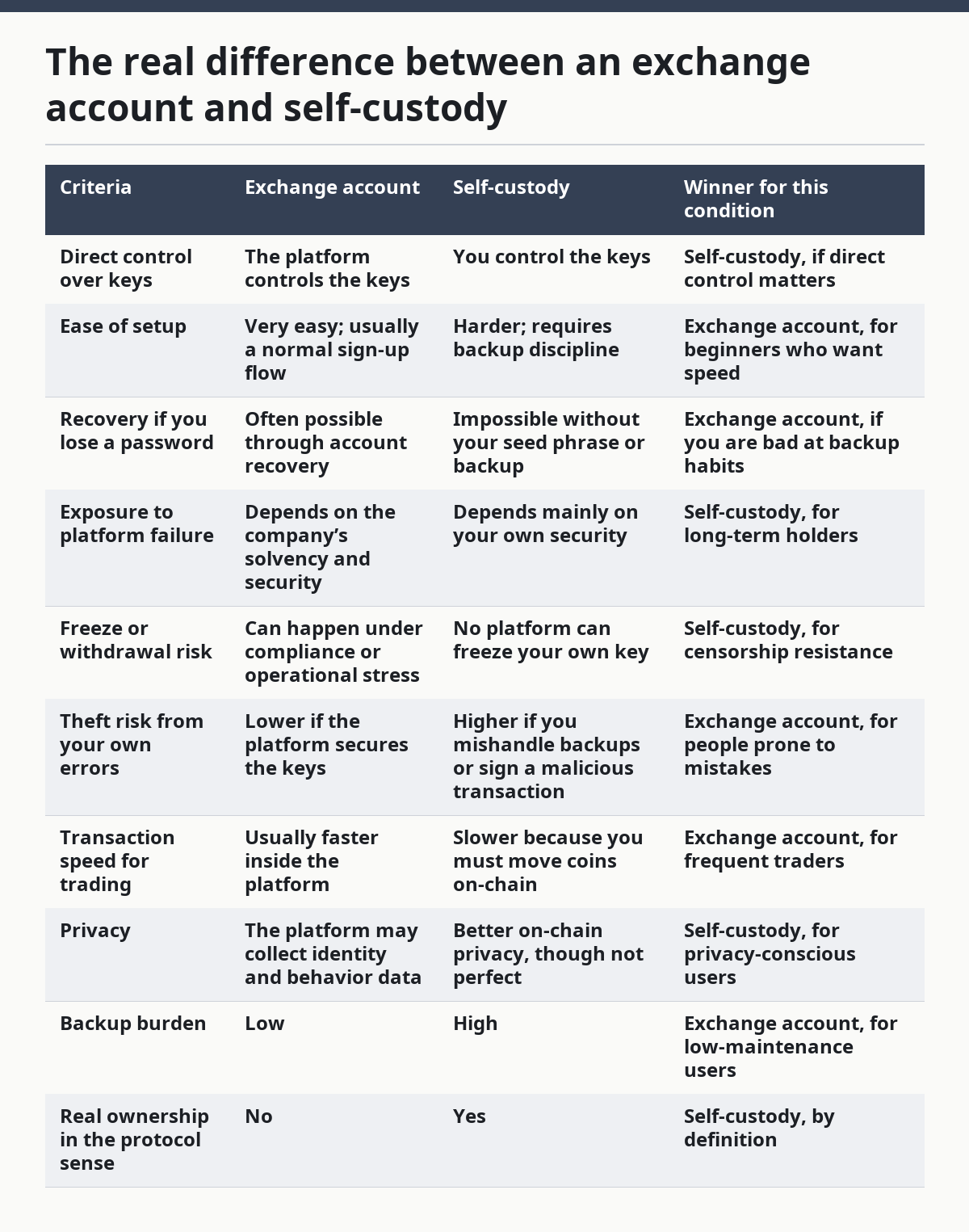
The table does not mean exchange custody is “bad.” It means it is a service model, not ownership in the strictest sense. If you want bitcoin as an asset to hold, self-custody is the cleaner choice. If you want bitcoin as a trading balance you may sell within days, a reputable exchange can be reasonable.
The weakness of exchange custody is obvious but easy to ignore: you are trusting the company’s controls, liquidity, and legal position. When that fails, the user usually learns about it after the fact. The weakness of self-custody is equally real: there is no help desk for a lost seed phrase, and no undo button for a bad backup.
What a Bitcoin wallet really does
A Bitcoin wallet does not hold bitcoin; it stores the keys or key material needed to spend it. That single sentence removes most beginner confusion.
A wallet can be a mobile app, desktop software, hardware device, or even a multisignature setup with separate devices. The phrase is misleading because it sounds like a container. It is not a container. It is a signing tool and a key manager.
The most common wallet forms are:
- Custodial app or exchange balance: easy access, but the platform controls the keys.
- Hot wallet: software on a phone or computer connected to the internet.
- Hardware wallet: a dedicated device that keeps signing material isolated from your everyday computer.
- Multisig setup: requires more than one key to move funds, often used for higher-value holdings.
The practical question is not which one sounds advanced. The question is which one matches the amount at stake and your tolerance for operational mistakes.
A hot wallet is fine for small, frequent spending. It is not ideal for life-changing savings because internet-connected devices are easier to compromise than isolated hardware. A hardware wallet reduces one major attack path, but it does not save a careless user from phishing, seed-phrase theft, or address replacement malware if the transaction is not checked carefully.
This is where many generic articles oversell the hardware wallet as a magic shield. It is not magic. It is a risk reducer. If you sign a malicious transaction, approve the wrong address, or expose your recovery phrase, a hardware device cannot rescue you.
The common beginner error is thinking the device itself is the owner. It is not. The keys are the important part. The device is only one way to keep those keys safer.
If you are deciding between wallets, the right frame is:
- Small balance, frequent use: hot wallet can be enough.
- Meaningful savings: hardware wallet is usually the better baseline.
- Large or shared holdings: multisig deserves serious consideration.
How to buy and receive bitcoin safely
You buy bitcoin on a regulated exchange or broker, then send it to an address you control if your goal is actual ownership. That is the core workflow, and the receiving step is where beginners most often make irreversible mistakes.
The basic process looks like this:
- Open an account with a platform that operates in your jurisdiction.
- Complete identity verification if required.
- Buy bitcoin with a supported payment method.
- Withdraw to your own address if you want self-custody.
- Verify the address and the network before confirming.
Step 4 is the one that turns a trading balance into self-custodied bitcoin. If you leave the coins on the platform, you have exposure to the platform, not direct possession of the keys.
The biggest safety issue is address verification. Bitcoin transactions are irreversible once confirmed. If you paste the wrong address, choose the wrong chain, or send to an incompatible network, the result can be permanent loss. A hardware wallet helps here because it allows you to verify the destination address on the device screen before approving.
A few practical rules make a real difference:
- Send a small test amount first when moving funds to a new address.
- Confirm the network matches the receiving address format.
- Never trust a copied address without checking at least the first and last characters.
- Do not rush because the market is moving.
- Use a reputable exchange with clear withdrawal procedures.
Transaction fees vary with network demand, and confirmation speed depends on fee level and mempool conditions. That means bitcoin is not always ideal for tiny, urgent payments. It works best when you can tolerate confirmation time and fee variability.
The trade-off is simple: the more control you want, the more careful you need to be. That is not a flaw unique to bitcoin. It is the cost of a bearer asset.
Security rules that matter more than price charts
Bitcoin security is mostly about keeping the private key, recovery phrase, and transaction approvals out of the wrong hands. Price discussion is loud; operational security is what prevents the loss, and if you are managing significant value, consult a professional on your storage setup.
The recovery phrase, often called a seed phrase, is a human-readable backup of the keys. Anyone who gets it can usually recreate the wallet and spend the funds. That means taking a photo of it, saving it in cloud storage, or typing it into a random website is a bad idea. Those are not edge cases. They are common failure modes.
The best habits are boring:
- Write the recovery phrase on paper or engrave it on a durable medium designed for the purpose.
- Store backups in separate physical locations.
- Never share the phrase with “support,” friends, or a device repair shop.
- Treat unsolicited download links as suspicious.
- Verify addresses on the device, not just on your computer screen.
A hardware wallet from a known manufacturer can reduce exposure to malware, but the phrase still needs careful protection. A passphrase feature can add an extra layer, but it also adds another thing that must be remembered exactly. If you forget it, the funds protected by that passphrase are effectively inaccessible.
This is the part of bitcoin ownership that is genuinely not for everyone. If your life situation makes secure backup impossible — for example, unstable housing, frequent travel without reliable storage, or a strong tendency to misplace important documents — then full self-custody may be the wrong choice for the moment. In that case, a reputable custodial platform may be safer than a self-managed setup you are likely to mis-handle.
Security is not about paranoia. It is about reducing the number of single points of failure.
Common mistakes that quietly destroy ownership
The worst bitcoin losses rarely come from sophisticated attacks. They come from ordinary mistakes that users made once and never got a second chance to correct.
The biggest ones are these:
- Leaving everything on an exchange forever: convenient, but it turns ownership into a platform claim.
- Losing the recovery phrase: without a backup, there may be no practical way back.
- Sharing the seed phrase with scammers: support impersonation remains a common social-engineering tactic.
- Sending to the wrong address: bitcoin transactions are not reversible in the normal consumer sense.
- Confusing the app with the asset: deleting a phone app does not erase bitcoin if the keys are backed up, but it can be catastrophic if you never saved the backup.
- Using one weak backup location: a single paper note in one drawer is not a recovery plan.
- Thinking price volatility is the main risk: for owners, custody error is often the more immediate danger.
These mistakes matter because they change who can control the coins, and that is the whole game. Bitcoin does not reward casual habits. It rewards careful ones.
The generic advice to “just buy and hold” is incomplete. Buying is the easy part. Holding securely through device loss, software changes, and phishing attempts is the real task.
When self-custody is the right choice, and when it is not
Self-custody is the right choice when the amount matters enough that you want direct control and you can follow a backup routine. It is not the right choice when you are likely to make a handling mistake that would be worse than the platform risk you are trying to avoid.
Choose self-custody if you:
- plan to hold for the long term,
- want to remove custodial counterparty risk,
- can store a recovery phrase securely,
- and are willing to verify every significant transfer.
Skip self-custody, at least for now, if you:
- are likely to lose backups,
- do not understand recovery procedures,
- need someone else to handle access and support,
- or only want exposure to bitcoin’s price without managing keys.
That last point is underrated. Some people want the asset’s market exposure, not the operational burden of ownership. For them, a regulated product or custodial account may fit better than personal key management. That is not “less serious.” It is a different risk profile.
A clean rule: if losing access would be financially painful and you cannot tolerate the possibility of making a catastrophic mistake, keep the setup simpler even if it means giving up some sovereignty. If you value direct control above convenience, self-custody is the better answer.
What bitcoin ownership means in real life
Bitcoin ownership means you can prove control with a signature, move the coins without permission, and recover access if your device fails but your backup survives. That is more demanding than owning a stock in a brokerage account, and that is exactly why people care about it.
The practical upside is independence. You do not need a bank’s operating hours, a card network, or a broker’s approval to send it. The practical downside is that there is no central party to fix your mistakes. The same design that protects you from intermediaries also removes the safety net.
That is why the right answer is not “bitcoin is easy” or “bitcoin is impossible.” The right answer is that bitcoin is straightforward once you understand keys, but unforgiving if you ignore them.
If the reader remembers only one thing, it should be this: exchange balances are claims, while self-custodied bitcoin is control. That single distinction explains nearly every ownership dispute, recovery failure, and security warning in the ecosystem.
The Verdict: Which ownership model should you choose?
Choose self-custody if you want direct control over your bitcoin, can protect a recovery phrase, and are holding more than a small trading balance for the medium or long term. Choose exchange custody if you are still learning, plan to trade soon, or know you are likely to mishandle backups. Neither if you cannot safely store recovery material or if losing access would be unacceptable.
That is the honest split. Self-custody gives you real ownership in the protocol sense, but it demands discipline. Exchange custody gives you convenience, but it turns ownership into trust.
FAQ
Is bitcoin really mine if it is on an exchange?
Only in the limited sense that the exchange shows it in your account. The exchange usually controls the private keys, which means it controls the actual spend authority. If you want direct ownership, withdraw to an address whose keys you control.
What happens if I lose my Bitcoin wallet?
If you lose the device but still have the recovery phrase, you can usually restore access on a new device. If you lose both the device and the backup, the funds may be permanently inaccessible. That is why the recovery phrase matters more than the app itself.
Is a hardware wallet necessary?
No, but it is often the better choice for meaningful long-term holdings. It lowers exposure to malware and makes address verification easier, yet it still depends on careful backup and safe use. For small amounts, a simpler setup may be enough.
Can someone steal bitcoin from just my address?
No, not from the address alone. A Bitcoin address is public by design, but spending requires the matching private key or signing authority. The risk comes from exposing the key, the recovery phrase, or signing a fraudulent transaction.
Should a beginner keep bitcoin on an exchange?
Sometimes, yes. If the amount is small, the holding period is short, and you are still learning the basics, an exchange can be a reasonable starting point. The moment the balance becomes meaningful, the case for moving to self-custody gets stronger.
Drafted with AI; not yet reviewed by a person.