Last updated: November 19, 2026
Quick Answer: For most readers, Crypto Exchanges and Trading Platforms — The Complete Guide points to one practical number: 1 decision. Pick a centralized exchange if you want the simplest route from bank money to crypto; pick a decentralized exchange if you already control a wallet and want on-chain trading.
In short: a crypto exchange is the place you use to convert money into crypto and back again, while a trading platform is the toolset you use to place and manage those trades; the right choice depends on how much control, cost, and custody you want. This guide, Crypto Exchanges and Trading Platforms — The Complete Guide, is information, not financial advice, and a qualified adviser should be consulted for your own situation.
Key Takeaways
- A crypto exchange connects buyers and sellers, and the platform handles orders, balances, and withdrawals.
- Crypto platforms are usually less standardized than stock brokers, which can affect support, fees, and custody.
- Centralized exchanges are usually the clearest bridge between bank money and crypto for beginners.
- Decentralized exchanges fit users who already use a wallet and want on-chain trades without giving custody to a company.
What a crypto exchange actually does
A crypto exchange is the market where buyers and sellers meet, and the platform around it handles orders, balances, and withdrawals. For a reader trying to move from “I have heard of Bitcoin” to “I need to understand how this works without making a costly mistake,” that is the first thing to get straight.
There are three moving parts that matter more than the marketing page:
- Custody — who holds the asset while you trade.
- Order matching — how your buy or sell request gets filled.
- Settlement and withdrawal — how coins or cash leave the platform.
A centralized exchange, such as Coinbase, Kraken, or Binance, usually keeps the order book and handles custody unless you withdraw to your own wallet. A decentralized exchange, such as Uniswap, uses smart contracts on a blockchain rather than a company-run order book. Those are not the same product, and a generic “crypto platform” label hides that difference.
The practical consequence is simple: if a platform holds your assets, it can freeze withdrawals, enforce account checks, and set listing rules. If you hold the keys yourself on a decentralized platform, you avoid the platform’s custody risk, but you take on wallet risk and network fees. That trade-off is the heart of the topic.
It also explains why “the best platform” is usually the wrong question. The better question is: do you need a regulated on-ramp, low-friction trading, advanced order types, self-custody, or token swaps that happen directly on-chain? Each of those needs pushes you toward a different kind of venue.
For context, major financial authorities keep warning that crypto assets can be volatile, hard to value, and exposed to fraud or operational failure. The U.S. Securities and Exchange Commission’s investor pages and the UK Financial Conduct Authority’s crypto guidance both make that point in plain language. A starting point for readers who want the regulator’s view is the SEC’s investor education on crypto assets and the FCA’s cryptoassets information hub.
How crypto trading platforms are different from ordinary stock brokers
Crypto platforms are usually less standardized than stock brokers, and that matters more than most newcomers expect. A stock broker operates inside a mature rulebook, with familiar protections, market hours, and standardized disclosures. Crypto platforms often combine brokerage functions, exchange functions, custody, staking, lending, and wallet services in one interface.
The first difference is market structure. Stock markets have named exchanges and a central clearing system. Crypto markets are fragmented across many venues, and prices can differ from one platform to another by a noticeable amount during fast moves. That means the “best” quote is often temporary, and the spread can widen when liquidity thins out.
The second difference is access and eligibility. Some platforms restrict products by country, state, or account type. A user in one jurisdiction may see margin trading, staking, or derivatives, while another user sees only spot buying. That is not a bug; it is a regulatory boundary.
The third difference is custody terms. On many crypto apps, the platform may say it holds digital assets on your behalf, but the legal relationship is not the same as a broker holding securities at a conventional custodian. Read the terms before assuming the same protection applies. If an exchange says it offers “insured” custody, that still does not mean your whole account is covered against every kind of loss.
The fourth difference is network dependence. Withdrawals can fail or pause because of blockchain congestion, maintenance, or chain-specific issues. A transfer that looks instant on the screen may take minutes or hours, and sometimes longer, depending on the chain and the platform’s risk checks.
For anyone used to brokerage apps, the sharpest surprise is that the platform can be both the marketplace and the vault. That concentration is convenient and risky at the same time. If you want a clean rule, use this one: the more a platform combines functions, the more carefully you need to read the custody and fee terms.
Centralized exchanges: who should use them and who should skip them
Centralized exchanges are the right starting point for most beginners because they are the clearest bridge between bank money and crypto. They usually accept card or bank transfers, show a familiar dashboard, and offer the simple “buy” button that most first-time users need.
Their strongest point is liquidity. Bigger centralized venues typically have deeper order books than small niche platforms, which can help reduce slippage on liquid pairs. That matters when you are trying to buy or sell at a known price rather than chasing a thin market. They also tend to support more fiat on-ramps than decentralized platforms, which is why many users start here.
Their second strength is account tools. Market orders, limit orders, stop orders, recurring purchases, and portfolio views are common on larger centralized exchanges. Some also provide API access for more advanced users. That makes them useful for someone who wants to graduate from simple app-based buying to more controlled execution.
The weakness is the same thing that makes them convenient: custodial risk and platform risk. If the exchange holds your assets, your access depends on its systems, its compliance decisions, and its internal controls. History has shown that exchange failure is not theoretical. Even well-known platforms can face insolvency, hacks, withdrawals pauses, or legal restrictions.
Centralized exchanges are also not ideal for anyone who wants full self-custody from the start. If your plan is to hold keys yourself and interact directly with blockchains, a centralized exchange can be only a temporary on-ramp. It may still be useful, but it is not the final destination.
Who should use one? A beginner who wants a familiar interface, bank transfer support, and an order book that is easier to understand than on-chain swapping. Who should skip one? A user who refuses to leave assets on a third-party platform, or who needs access to self-custody-only workflows from day one.
Decentralized exchanges: what they solve, and what they complicate
Decentralized exchanges are the better fit when the user already controls a wallet and wants to trade on-chain without handing custody to a company. They shine when a reader wants direct access to token swaps, self-custody, and permissionless listings.
Their clearest strength is control. On a decentralized exchange, you sign transactions from your own wallet and keep custody of the keys unless you deliberately hand them off. That removes the single-company custody model that centralized venues use. It also means there is no conventional account lock in the same way there is on a custodial platform.
Their second strength is on-chain access. Many tokens appear on decentralized venues before they reach a major centralized exchange, and some never list on centralized platforms at all. That makes decentralized venues useful for experienced users who need broader token access or who work within specific blockchain ecosystems such as Ethereum or Layer 2 networks.
The trade-off is real and often underestimated. Decentralized exchanges put more responsibility on the user. Wallet setup, seed phrase storage, gas fees, transaction approvals, and network selection all matter. A mistake can be costly, and there is often no customer service line that can reverse an error.
Price execution can also be worse than many newcomers expect. Thin liquidity, high volatility, and sandwich attacks or other forms of MEV on some chains can affect the final outcome. Even when the interface looks simple, the underlying trade mechanics are not simple. A user may also face higher or less predictable network costs depending on congestion and the chain being used.
So the match is narrow and specific: a decentralized exchange is best for an experienced user who already understands wallet security, on-chain confirmation times, and token contract risk. It is not the best place for a first-time buyer who still wants the platform to handle too many decisions.
What matters most before you open an account
The right platform is usually the one that matches your risk tolerance and your actual workflow, not the one with the slickest homepage. Before you open an account, I would check six things in this order.
Regulation and availability
Is the platform available in your country, and is it permitted to offer the service you want there? A platform can be legitimate in one jurisdiction and unavailable in another. If your region restricts crypto derivatives, staking, or certain tokens, the platform may simply hide those features.
Custody and withdrawal policy
Does the platform hold the assets, or do you control the wallet? If the platform holds them, what are the withdrawal limits, review periods, and compliance checks? The terms matter more than the app design.
Fee structure
Does the platform charge a spread, a visible trading fee, a withdrawal fee, or all three? Some platforms advertise low fees but make money through spread or pricing markups. Others show a direct fee but add network charges at withdrawal.
Liquidity
Can you trade the amount you actually need without moving the market? A platform with thin liquidity can look cheap until slippage turns a small fee into a worse overall execution price.
Security controls
Does the platform support two-factor authentication, withdrawal allowlists, device management, and account alerts? Those features do not make a platform risk-free, but they do reduce avoidable mistakes.
Tax reporting support
Does the platform provide transaction exports that you can hand to a tax professional or use in your own records? Crypto tax rules differ by country and change often, so clean records matter more than most users realize.
A reader who skips this checklist usually ends up choosing by branding. That is the wrong filter. In crypto, the fine print often matters more than the interface.
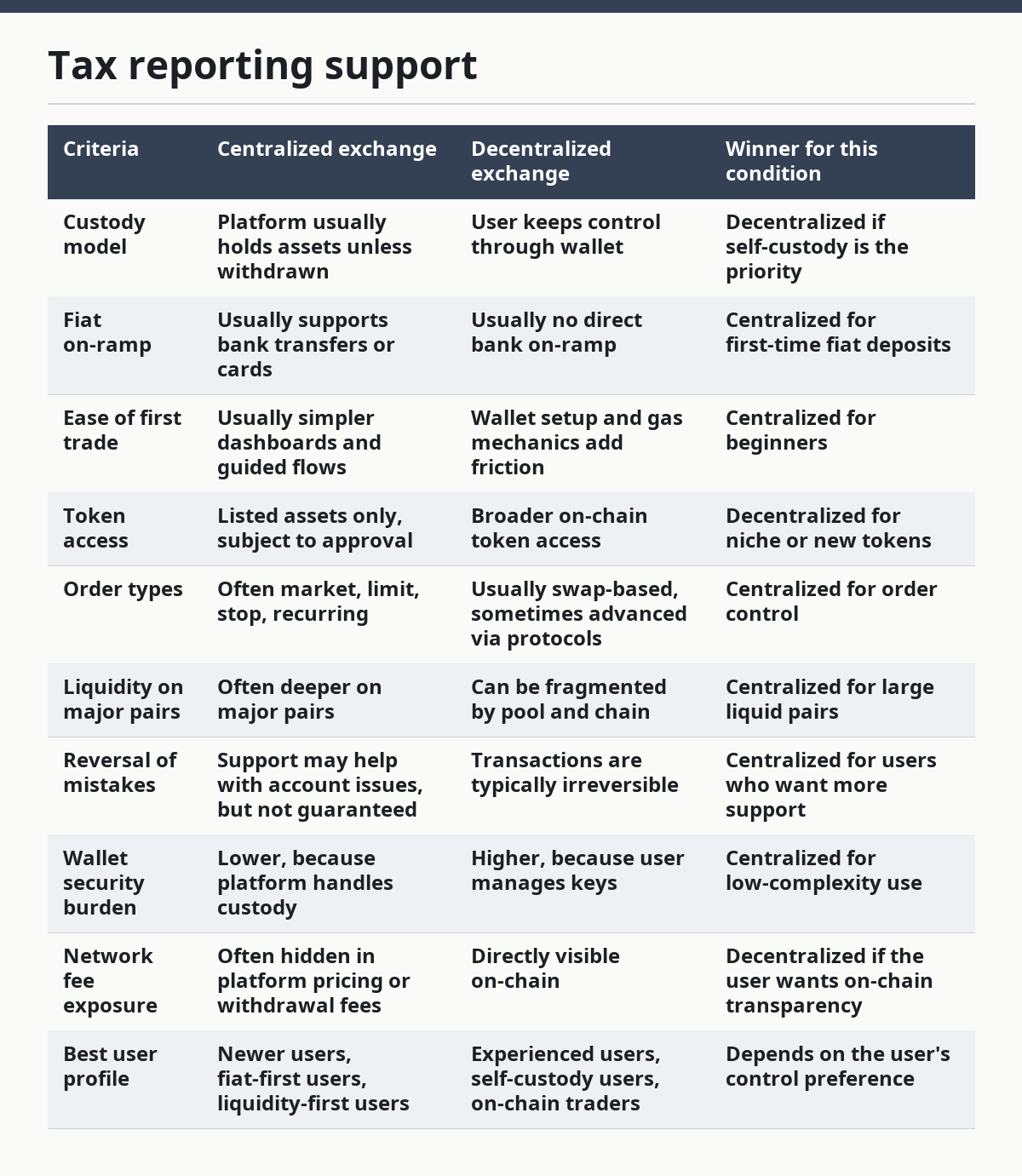
| Criteria | Centralized exchange | Decentralized exchange | Winner for this condition |
|---|---|---|---|
| Custody model | Platform usually holds assets unless withdrawn | User keeps control through wallet | Decentralized if self-custody is the priority |
| Fiat on-ramp | Usually supports bank transfers or cards | Usually no direct bank on-ramp | Centralized for first-time fiat deposits |
| Ease of first trade | Usually simpler dashboards and guided flows | Wallet setup and gas mechanics add friction | Centralized for beginners |
| Token access | Listed assets only, subject to approval | Broader on-chain token access | Decentralized for niche or new tokens |
| Order types | Often market, limit, stop, recurring | Usually swap-based, sometimes advanced via protocols | Centralized for order control |
| Liquidity on major pairs | Often deeper on major pairs | Can be fragmented by pool and chain | Centralized for large liquid pairs |
| Reversal of mistakes | Support may help with account issues, but not guaranteed | Transactions are typically irreversible | Centralized for users who want more support |
| Wallet security burden | Lower, because platform handles custody | Higher, because user manages keys | Centralized for low-complexity use |
| Network fee exposure | Often hidden in platform pricing or withdrawal fees | Directly visible on-chain | Decentralized if the user wants on-chain transparency |
| Best user profile | Newer users, fiat-first users, liquidity-first users | Experienced users, self-custody users, on-chain traders | Depends on the user’s control preference |
What fees really cost you on a crypto platform
Fees are not just the trading fee shown on the screen, and the wrong comparison can make a platform look cheaper than it is. A careful reader should compare four separate costs: trading fee, spread, deposit cost, and withdrawal cost.
The trading fee is the direct charge for placing the order. It may be flat, tiered, or based on maker and taker status. Maker orders add liquidity; taker orders remove it. Some platforms reward makers with lower fees, while others do not.
The spread is the gap between the buy and sell quote. A platform can advertise a low fee and still make the effective cost high if the spread is wide. This is especially relevant on thinly traded pairs and during volatile periods.
The deposit cost depends on how you fund the account. Bank transfers may be cheaper than card purchases, but availability varies by country. Card purchases can be quicker but often carry higher implicit costs. Platform policies change, so the exact charge should be checked inside the account before funding.
The withdrawal cost is often overlooked. On centralized platforms, withdrawal fees can be fixed or dynamic. On-chain withdrawals also depend on network congestion and the chain you choose. Ethereum mainnet fees can be materially different from fees on a Layer 2 or alternative chain, and those costs can change quickly.
A reader should also watch for conversion charges. Some apps do not show a separate fee but widen the conversion rate instead. That can be fine for convenience, but it should be understood as a cost.
The honest conclusion is that the cheapest-looking platform can be expensive once all four costs are added up. A small trade on a high-spread platform may cost more in practice than a larger trade on a more transparent venue. That is why cost comparisons should include the full path from deposit to withdrawal, not just the button labeled “buy.”
Which platform fits a beginner, a frequent trader, or a self-custody user?
The right platform depends on your main constraint, and the constraint changes by user type.
For a beginner, a centralized exchange wins because the first problem is not sophistication; it is avoiding confusion. A clear deposit path, visible balances, and support for bank transfers matter more than advanced on-chain features. The drawback is that the beginner is also taking on custody risk by leaving assets on a third-party platform, so that user should learn withdrawal basics early.
For a frequent trader, a centralized exchange is usually the better fit if the priority is order types, liquidity, and quicker execution on major pairs. The user can place limit orders, use chart tools, and manage positions more cleanly than on many decentralized venues. The downside is counterparty risk, which becomes more important the longer funds stay parked there.
For a self-custody user, a decentralized exchange is the natural match because the wallet remains central to the workflow. That user accepts gas fees and transaction complexity in exchange for direct control. The risk is operational: the user must manage approvals, chain selection, and seed phrase protection carefully.
For a long-term holder who trades rarely, neither platform should be treated as a storage solution. That user may need a platform only for occasional conversion, while most assets belong in a custody arrangement the user understands and can secure. The exact setup should be discussed with a qualified adviser if the amounts are material, and a tax professional can help with local rules.
The reader should resist one common mistake: confusing convenience with suitability. The app that feels easiest on day one is not always the best fit for the next year of use. A platform should match your habits, not your curiosity.
When does the verdict flip?
The overall verdict flips in a few specific cases, and these are the situations that generic articles usually ignore.
If your country restricts access to centralized platforms but permits wallet-based swaps, a decentralized exchange may be the only practical route. That does not make it simpler; it just makes it available.
If you need fiat on-ramp support and straightforward records for deposits and withdrawals, a centralized exchange usually wins because it is built for that exact job. A decentralized exchange generally is not.
If you are trading a token that is not listed on major centralized venues, a decentralized exchange may be the only place where liquidity exists. In that case, the cost is higher operational complexity and potentially weaker pricing.
If you cannot comfortably manage a seed phrase or hardware wallet, a decentralized exchange is the wrong starting point. The wallet is not a side issue; it is the main security boundary.
A final flip case matters for readers dealing with significant money: if the amounts are large enough to affect your tax position, inheritance plan, or household finances, a qualified financial or tax adviser should review the setup. Crypto tax treatment varies by country and can change, so the right answer can depend on where you live and how you report.
The plain-English verdict
Choose a centralized exchange if you want the simplest route from bank money to crypto, need stronger liquidity on major pairs, and are willing to accept third-party custody. Choose a decentralized exchange if you already understand wallets, want direct on-chain control, and need access to assets or protocols that never pass through a traditional exchange. Neither if you are treating the platform as a place to park money you cannot afford to lose or cannot explain to a tax professional.
That is the cleanest answer for most readers. Centralized venues are the better starting point for most new users and many active traders. Decentralized venues are the better fit for users who already know why self-custody matters and are prepared to handle the extra complexity.
The wrong move is choosing by brand name alone. The right move is matching the platform to your use case, your jurisdiction, and your tolerance for custody risk.
What many guides leave out
The usual article stops at “centralized versus decentralized” and pretends that the choice is just about convenience. That misses the part that causes real problems: platform risk, legal availability, withdrawal controls, and recordkeeping.
A better guide would say this plainly: the exchange is not just a shop. It is a market, a storage layer, and often a compliance gate. That means the same platform can be fine for a small, occasional conversion and a poor choice for frequent trading or large balances.
It also matters that crypto platforms are not one thing. Some are pure exchanges. Some are broker-style apps with built-in spreads. Some offer wallets, staking, lending, or perpetual futures in the same login. Those bundles change the risk profile. A reader should not assume every feature on the menu belongs in the same decision.
Finally, the tax angle is not optional. Even when the platform is easy to use, the after-the-fact reporting can be messy. Transaction logs, fee records, and withdrawal history should be saved from day one. The platform may provide exports, but the user should not assume those exports will always be available forever.
If the only thing this article changes is the way you compare fee screens, custody terms, and withdrawal policies, it has done its job.
Drafted with AI; not yet reviewed by a person.