Last updated: November 19, 2026
Quick Answer: most crypto trading losses come from 3 things you can control immediately: thin liquidity, weak account security, and the wrong order type. Crypto trading safety and market mechanics are risky because the market never closes, prices can move fast, and the plumbing behind the trade matters as much as the coin itself. The answer is to understand order types, custody, fees, slippage, and the common scams before you place a trade. This guide on crypto trading safety and market mechanics settles what those pieces do, where traders get burned, and what to check before money moves.
I write on crypto markets and personal finance, and this is information, not financial advice; for your own situation, a qualified adviser should review the tax, legal, and account setup issues that apply where you live. Consult a qualified professional if your custody, tax, or legal situation is unclear, and review the SEC investor resources at https://www.investor.gov/ before acting.
Key Takeaways
- Crypto prices can move in thin order books, so the trade you click and the fill you get may differ.
- The exchange’s rules, your order type, and the spread can cost more than the headline fee.
- Self-custody shifts control to you, but it also shifts backup, recovery, and scam risk to you.
- Liquid markets with deep books usually behave better than tiny tokens with few bids and asks.
- The main safety job is boring: verify the venue, harden your account, size trades small, and know the exit before you enter.
What actually happens when you place a crypto trade?
A crypto trade matches your order with someone else’s order on an exchange, and the fill price depends on the book at that moment. If you use a market order, you accept the available price; if you use a limit order, you ask for a price and wait for a match.
Here’s the catch: the market can look calm on the chart while the order book is thin under the surface. A single medium-sized order can move price, especially in smaller pairs. That is why the listed price and your actual fill can differ.
A few mechanics decide most of the result:
- Bid and ask: buyers line up on the bid, sellers on the ask.
- Spread: the gap between the best bid and best ask can widen or narrow.
- Slippage: the difference between the price you expected and the fill you get.
- Liquidity: how easily the market absorbs orders without jumping around.
- Market depth: how much size sits near the current price.
On large venues, liquid pairs often trade with tight spreads. On smaller tokens, the spread can widen fast during news, volatility, or low-volume hours. The SEC’s investor guidance on crypto asset risks is a useful starting point for understanding that execution risk exists even when a screen looks stable.
Why does the same coin cost different amounts on different exchanges?
The same coin can cost different amounts because each exchange has its own order book, fees, and user mix. A venue with more active traders may show tighter pricing; a thinner venue may show wider spreads and larger gaps between orders.
The truth is, price discovery is local until the trade is matched. If one exchange has a rush of buyers and another has more sellers, the quotes split. Cross-exchange arbitrage usually narrows those gaps, but not instantly.
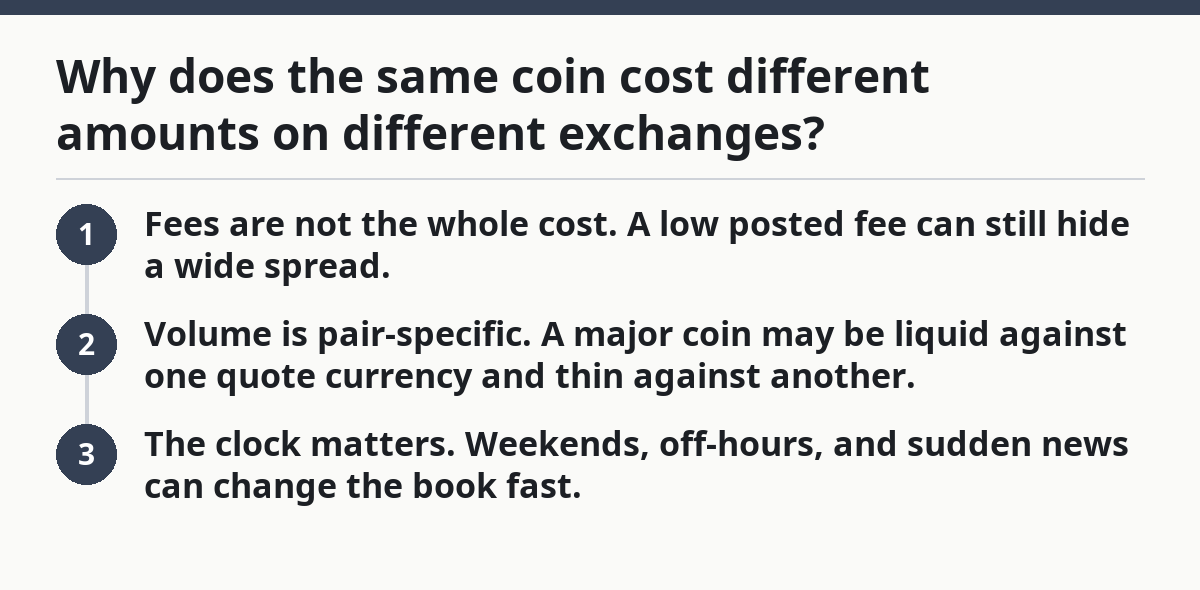
A beginner often misses three things:
- Fees are not the whole cost. A low posted fee can still hide a wide spread.
- Volume is pair-specific. A major coin may be liquid against one quote currency and thin against another.
- The clock matters. Weekends, off-hours, and sudden news can change the book fast.
A simple way to think about it: the market does not owe you the last displayed price. It gives you the price available when your order reaches the book. The FCA’s consumer warnings on unauthorised firms and scams are relevant here because venue quality and access risk can affect what you actually receive.
How do order types change your risk?
Order type changes whether you control price, speed, or neither. A market order favors speed and can eat through levels in a thin book; a limit order favors price control and can leave you unfilled.
Picture this: you’re trying to buy into a fast move and the screen shows a price you like. You click market order, and the fill lands higher because the available asks vanished before the engine matched you. That is not a bug. That is market mechanics.
The main order types matter in different ways:
- Market order: fastest, least control over final price.
- Limit order: better price control, no guarantee of execution.
- Stop order: triggers at a level you set, then turns into a market or limit order depending on venue rules.
- Stop-limit order: gives more price control after the trigger, but can miss the fill if the market gaps through the limit.
The key trade-off is simple. If you need certainty of entry or exit, you accept slippage risk. If you need price discipline, you accept execution risk. NIST digital identity guidance is also relevant to trading accounts because strong authentication reduces the chance that a bad login becomes a bad trade.
Which market mechanics hurt beginners most?
Beginners usually lose more to structure than to prediction. The biggest traps are thin liquidity, widening spreads, leverage, and funding or liquidation rules that turn a small mistake into a big one.
Now, you might be wondering why a chart looks “safe” and then the trade still goes wrong. The answer is that charts show past prints, not the live queue. On a fast move, the queue can disappear before your order arrives.
The usual pain points are:
- Thin books on smaller tokens
- Leverage that magnifies losses
- Liquidation rules that close positions automatically
- Funding rates on perpetual futures that change holding cost over time
- Gaps that jump over your stop price
A trader who only watches candles misses the plumbing. A trader who watches the book, the spread, and the venue rules sees the real risk. In particular, a $10,000 order can behave very differently in a deep pair than in a shallow one.
How do you trade crypto more safely?
Safer crypto trading starts with account security, venue checks, and small position sizes, not with a fancy strategy. The first job is to reduce the chance that a mistake, hack, or bad fill wrecks the account.
Here’s the catch: “safe” does not mean “risk-free.” It means the setup makes fraud, loss, and operational mistakes less likely.
A practical safety checklist:
- Use a strong, unique password and a password manager.
- Turn on 2-factor authentication with an authenticator app, not just SMS.
- Check the exchange’s legal entity, fee schedule, withdrawal rules, and supported jurisdictions.
- Test withdrawals with a small amount before sending more.
- Keep only trading funds on the exchange; store long-term holdings separately.
- Verify the exact website, app publisher, and deposit address every time.
- Read the listing rules for the pair you trade, including minimum order size and withdrawal lockups.
If the platform cannot clearly explain custody, fees, or withdrawal timing, that is a warning sign. So is pressure to deposit more money right away. The SEC, FCA, and NIST all publish public guidance that can help you compare a platform’s claims with basic security and investor-protection expectations.
What are the biggest scams and failure points?
The biggest scams exploit urgency, confusion, and trust in a fake interface. The most common losses come from phishing sites, fake support agents, malicious wallet approvals, cloned apps, and rug pulls in low-quality tokens.
Picture this: you get a message that looks like support, the site looks right, and the login screen feels familiar. One bad click can hand control of an account or wallet to a thief. Crypto scams often work because the workflow is fast and the user is tired.
The failure points worth knowing:
- Phishing links that mimic an exchange or wallet login.
- Fake customer support in chat apps and social media.
- Approval scams that ask for broad token permissions.
- Deposit address spoofing that swaps one string for another.
- Rug pulls where a token’s liquidity or ownership is manipulated.
- Draining browser extensions that overreach permissions.
The best defense is slow verification. Check the URL, bookmark the real site, and never trust a message that creates urgency around private keys, seed phrases, or withdrawals. The FCA consumer pages are a useful reference for scam awareness, and they are worth checking before you move money.
Crypto trading safety and market mechanics: what the numbers and rules really mean
Crypto trading safety and market mechanics come down to four live variables: price, spread, depth, and control. If you know those, you can read the trade better than a chart alone can.
Markets are not all built the same. A major pair on a large exchange may have a tight spread and deep books, while a smaller token may trade with gaps large enough to matter on a modest order. That difference is why the same strategy can behave well in one market and badly in another. In practice, a 1% move on a thin pair can be less informative than a 0.2% move on a liquid one.
A few rules of thumb help:
- A wider spread means a higher built-in cost to enter and exit.
- A shallower book means larger slippage on larger orders.
- Leverage lowers the margin for error.
- Perpetual futures add funding costs and liquidation risk.
- Cross-margin can tie positions together so one loss affects others.
This is where many generic guides go wrong: they talk about “volatility” as if it were one thing. It is not. There is price volatility, but there is also liquidity volatility. The second one is what turns a decent-looking trade into a bad fill.
How do I read the order book without getting lost?
You read the order book by looking for size, gaps, and how close liquidity sits to the current price. The best clue is usually not the biggest number on the screen; it is the shape of the book around the spread.
Picture this: you’re looking at a pair with a low headline price and think it must be cheap. Then you notice the asks thin out quickly above the last trade. That means the market may not absorb your order cleanly.
What to check:
- Spread width near the current price
- Depth at each level above and below
- Repeated walls that may vanish when touched
- Trade prints that show whether actual size is crossing the book
- Volume by pair, not just volume by coin
A book can look thick and still be fragile if size is fake or concentrated in a few layers. A live market shows consistent participation, not just a decorative stack of orders. If a $5,000 order clears several levels, that is a concrete sign that displayed liquidity was thin.
Custody, wallets, and why “safe” depends on who holds the keys
Custody decides who can move the asset, and that choice changes the whole risk profile. On a custodial platform, the venue controls the keys; in self-custody, the holder controls them and also carries backup and recovery risk.
The trade-off is real. A custodial setup can be easier for fast trading, but it adds platform risk, withdrawal limits, and account freeze risk. Self-custody reduces dependence on one company, but a lost seed phrase or bad approval can be fatal.
A few points matter here:
- Seed phrase protection is not optional in self-custody.
- Hot wallets are convenient but exposed to more online risk.
- Cold storage is better for long-term holding, not active trading.
- Exchange custody can be practical for frequent trades, but only for balances you are willing to keep there.
The wrong move is to treat custody as a minor detail. It is the root of recovery, access, and loss. If you are unsure how to structure custody for your account and position size, speak with a qualified professional and review the platform’s official security guidance before you rely on it.
When should a trader avoid the market altogether?
A trader should avoid the market when the pair is illiquid, the rules are unclear, or the urge to act is stronger than the plan. If the spread is wide, the venue is unfamiliar, or the token depends on hype more than use, the risk usually outruns the setup.
Here’s the catch: not trading is a position too. Waiting is often smarter than forcing a thin market.
Red flags that should pause the trade:
- The order book is thin and the spread jumps around.
- The platform cannot explain fees, withdrawals, or custody.
- The asset has little real volume outside a single venue.
- The token’s ownership, liquidity lock, or contract controls are unclear.
- The trade depends on borrowed money and a tight stop.
That last one is dangerous. Leverage plus low liquidity can turn a small move into an account problem. A 2% move against a leveraged position can be enough to matter if liquidation is close.
What’s the difference between spot trading and derivatives?
Spot trading means you buy or sell the asset itself, while derivatives let you speculate on price without owning the underlying coin in the same way. Derivatives add funding, liquidation, and contract-specific rules that do not exist in basic spot trading.
The practical difference is control. Spot is simpler to understand and easier to reason about. Derivatives can hedge or magnify exposure, but they also create new ways to lose money fast.
A beginner should know the main moving parts:
- Spot: direct ownership of the asset, simpler mechanics.
- Perpetual futures: no expiry date, but funding and liquidation matter.
- Options: more complex pricing and time decay.
- Margin: borrowed funds that increase both upside and downside.
If the goal is learning mechanics, spot is the cleaner starting point. Derivatives belong to traders who already understand position size, margin rules, and forced liquidation.
What a good crypto trading routine looks like
A good routine is dull, repeatable, and strict about checks. It starts with the venue, then the pair, then the order type, then the exit plan.
Before any trade, a careful routine might look like this:
- Confirm the site, app, and login method.
- Check the pair’s spread and visible depth.
- Decide whether the order needs price control or speed.
- Set the trade size before entering the ticket.
- Know the stop, target, and invalidation point.
- Verify the withdrawal path if money needs to leave the venue.
The routine protects against emotional clicks. It also makes the mechanics visible before money is exposed.
What do the leading sources say about exchange safety?
The leading source material comes from regulators and standards groups, because they define the risks without marketing spin. For account security, the U.S. Securities and Exchange Commission has plain-language investor guidance on crypto assets, and the UK’s Financial Conduct Authority regularly warns about scams and unauthorised firms. For custody and security controls, standards bodies such as NIST publish identity and authentication guidance that helps explain why strong login security matters.
Useful references include:
- U.S. SEC investor resources on crypto asset risks: https://www.investor.gov/
- U.K. Financial Conduct Authority consumer warnings: https://www.fca.org.uk/consumers
- NIST Digital Identity Guidelines: https://pages.nist.gov/800-63-3/
These pages do not tell you how to trade a pair, but they do explain the security and identity issues that shape safe access to a platform. If a venue’s setup conflicts with those basics, that matters.
The verdict: what matters most, and what doesn’t
The safe path is to treat crypto trading as a market-structure problem first and a price-prediction problem second. A strong strategy can still lose money in a thin book, on a bad order type, or through a weak custody setup.
Choose spot trading if you want simpler mechanics and can live without leverage. Choose derivatives only if you already understand liquidation, funding, and margin rules. Neither is a good fit if you are using borrowed money, trading a thin token, or logging in through a link you did not verify.
The biggest mistake is chasing movement before you understand the route the order takes. That route decides the damage.
FAQ
Is crypto trading safe for beginners?
Crypto trading is not safe in the absolute sense, because price moves, platform risk, and scams are always present. It can be made safer by using strong account security, avoiding leverage, and sticking to liquid pairs on known venues. Beginners still need to accept that losses can happen fast.
What is slippage in crypto trading?
Slippage is the gap between the price you expected and the price you actually get. It usually gets worse when the market is moving quickly or the order book is thin. Market orders are the most exposed to it.
Is a custodial exchange account better than self-custody?
A custodial account is easier for active trading, but it puts access and withdrawal control in the platform’s hands. Self-custody gives more control over the keys, but it also makes backup and recovery your problem. The better setup depends on how often you trade and how much operational risk you can handle.
Why do my crypto trades fill at different prices?
Your fills change because the order book shifts while your order is moving through the market. Spread, depth, and volatility all affect the final price. Even a large exchange can show different fill results at different times of day.
Should I use leverage in crypto?
Leverage can amplify both gains and losses, and it adds liquidation risk that many beginners do not fully understand. If the goal is learning, spot trading is the simpler place to start. Leverage belongs only in a plan that already accounts for forced exits, fees, and margin rules.
Drafted with AI; not yet reviewed by a person.