
Last updated: November 19, 2026
Key Takeaways
- Start with wallets, exchanges, private keys, and risk before charts or “hot coins.”
- Ask questions that protect money, identity, and access, not quick gains.
- Wallets and exchanges serve different roles, and mixing them up causes beginner mistakes.
- Phishing, wrong-network transfers, custody failures, and rule changes are major risks.
Crypto guides help you learn how cryptocurrency works, what the main risks are, and which questions matter before you touch an app or wallet. This is information, not financial advice, and a qualified adviser should be consulted for your own situation. The section on Crypto Guides: Your Path to Cryptocurrency Knowledge: related questions below sorts out the questions beginners ask most, so you can judge a guide before you trust it.
What should a good crypto guide teach first?
A good crypto guide should teach wallets, exchanges, private keys, and risk before it teaches charts or “hot coins.” That order matters because many losses in crypto come from sending funds to the wrong address, falling for fake apps, or losing access to a wallet seed phrase.
Picture this: you want to learn crypto without getting buried in jargon, and you need a path that starts with the basics and does not skip the parts that can cost you money. A strong guide explains the moving pieces in plain language and shows where each piece fits. If a guide jumps straight to price talk, it is skipping the dangerous part.
A solid beginner guide should answer these questions clearly:
- What is a blockchain, in plain English?
- What is the difference between a wallet and an exchange?
- What is a private key or seed phrase, and why does it matter?
- What can go wrong when a transfer is sent to the wrong network?
- How do fees work, and why do they change?
The SEC’s investor education pages and the FDIC’s crypto-related consumer guidance are useful starting points because they focus on basic risks, not hype. The exact rules and warnings differ by country, though, so a guide should say when a point is local law rather than universal fact. See the SEC’s investor resources at https://www.sec.gov/investor and the FDIC’s consumer page at https://www.fdic.gov/resources/consumers/consumer-news/2022-06.html.
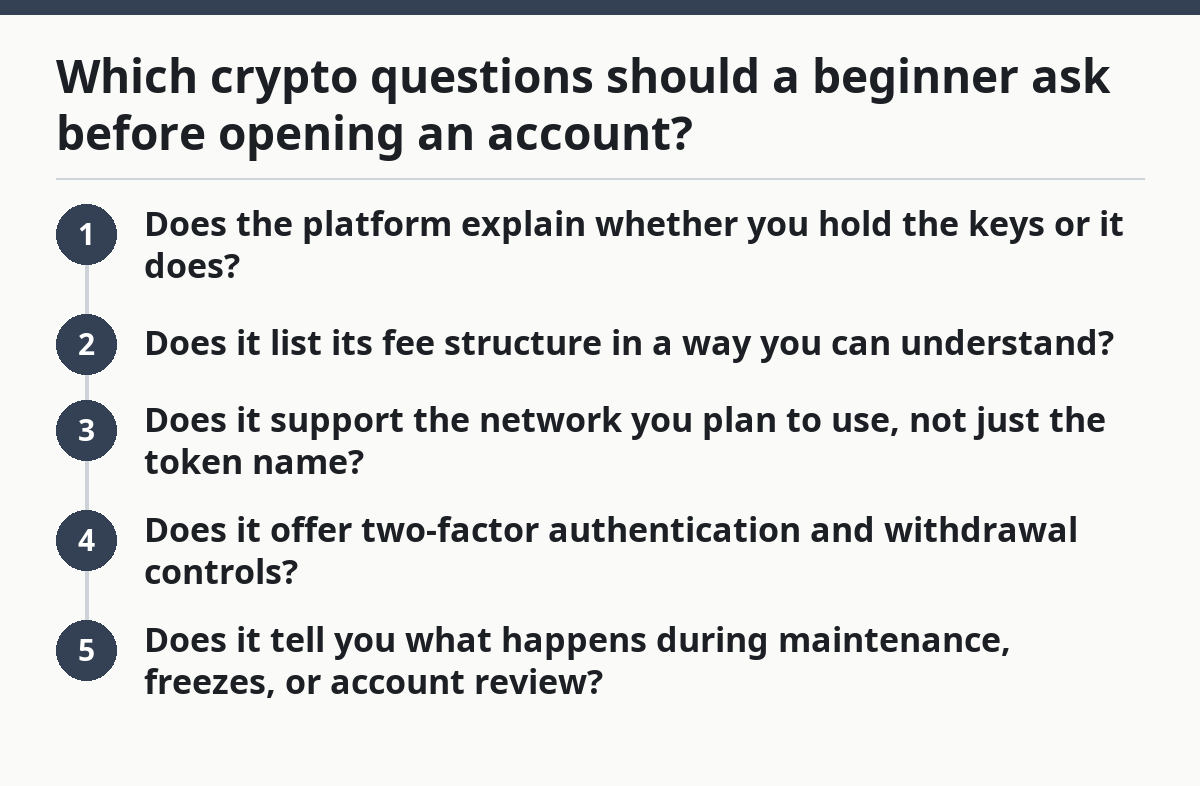
Which crypto questions should a beginner ask before opening an account?
The right crypto questions are the ones that protect your money, identity, and access, not the ones that chase quick gains. A beginner should ask about custody, fees, supported networks, security controls, and what happens if the platform freezes withdrawals.
Picture this: you are about to create an account and the site looks polished, but the real issue is not the design. The real issue is who controls the assets, how you can move them, and what protections the platform actually offers. That is the difference between learning and guessing.
Use this short checklist before you sign up:
- Does the platform explain whether you hold the keys or it does?
- Does it list its fee structure in a way you can understand?
- Does it support the network you plan to use, not just the token name?
- Does it offer two-factor authentication and withdrawal controls?
- Does it tell you what happens during maintenance, freezes, or account review?
A guide that answers those points is doing real work. A guide that only talks about charts and “signals” is not teaching knowledge; it is teaching noise. The Consumer Financial Protection Bureau and the UK Financial Conduct Authority both publish consumer warnings about crypto risks, and those warnings are worth reading even if you never open an account. See the CFPB at https://www.consumerfinance.gov/ and the FCA at https://www.fca.org.uk/consumers/cryptoassets.
How do wallets and exchanges differ in real life?
Wallets and exchanges are not the same, and mixing them up causes a lot of beginner mistakes. An exchange is a trading venue, while a wallet is where you control or store access to crypto assets, depending on the wallet type.
Picture this: you bought some crypto on an app and now you are told to “withdraw to your wallet.” If you do not know whether that wallet is self-custody or managed by a company, you can make a costly mistake. The difference is control, not just software.
Here is the practical split:
- Exchange: best for buying, selling, and converting assets on the platform.
- Custodial wallet: the company holds the keys.
- Self-custody wallet: you hold the keys and the responsibility.
- Hardware wallet: a physical device used for self-custody, often for longer-term storage.
This is where many generic guides fail. They explain wallets as if all wallets work the same way, but they do not. A self-custody wallet can give you more control, yet it also means a lost seed phrase can mean lost access. A custodial setup can be easier to use, yet it adds counterparty risk if the platform has trouble.
The NIST and CISA cyber guidance is useful here because it explains why strong authentication, device hygiene, and phishing awareness matter. A good crypto guide should connect those security basics to the tools you use. See NIST at https://www.nist.gov/ and CISA at https://www.cisa.gov/topics/cybersecurity-best-practices.
What are the biggest risks most guides leave out?
The biggest risks are phishing, wrong-network transfers, custody failures, and regulatory change. A beginner who only learns “how to buy” gets half the picture; the other half is how people lose access or send money to a place they cannot recover from.
Picture this: you copy an address from one tab, paste it into another, and send funds across the wrong chain or to a typoed address. No customer support line can promise recovery. That is why a careful guide slows you down before each action, not the one that makes everything sound easy.
Common risks worth spelling out plainly:
- Phishing: fake links, fake support chats, fake wallet prompts.
- Wrong network: the token name can look right while the network is wrong.
- Scams: fake returns, impersonation, and pressure tactics.
- Custody risk: a platform can restrict access, freeze withdrawals, or face failure.
- Rule changes: taxes, reporting, and access rules differ by country and can change.
A generic article often misses the tax point, but that is a mistake. Local tax treatment can change the real result of a crypto transaction, and rules are not universal. Read your tax authority’s current guidance, and if a transaction matters to your finances, a qualified tax professional is worth consulting. The IRS, HMRC, and CRA each publish crypto guidance that changes over time; see the IRS at https://www.irs.gov/businesses/small-businesses-self-employed/digital-assets, HMRC at https://www.gov.uk/guidance/cryptoassets, and CRA at https://www.canada.ca/en/revenue-agency/services/tax/individuals/topics/about-your-tax-return/tax-return/completing-a-tax-return/digital-currency.html.
How can you tell if a crypto guide is trustworthy?
A trustworthy crypto guide names risks, separates opinion from fact, and avoids promising outcomes. It should cite official sources, explain what it does not know, and never sound like a sales page dressed up as education.
Picture this: you land on a guide that sounds confident, but every paragraph pushes one platform, one token, or one “simple method” to make money. That is not education. A credible guide teaches you how to think, not what to chase.
Look for these signs:
- It uses source names like SEC, FCA, FINRA, IRS, or an equivalent national regulator.
- It explains fees, custody, and security without hype.
- It says when laws and tax rules vary by country.
- It warns about scams instead of implying the market is easy.
- It avoids absolute language like “safe,” “guaranteed,” or “risk-free.”
A trustworthy guide does not need flashy language. It uses plain words, tells you where the limits are, and does not pretend that every reader has the same goal or risk tolerance. That honesty matters more in finance than in almost any other topic.
What should you learn next if you already know the basics?
You should learn security, transaction flow, and tax basics next, because those are the skills that stop beginner mistakes from becoming expensive mistakes. After that, you can study token types, network fees, and how to read platform disclosures.
Picture this: you already know what a wallet is, but you still do not know how to check an address format, compare network fees, or spot a fake support message. That is the stage where practice matters more than theory. Move from reading to checking.
A useful learning order looks like this:
- Learn how to verify the domain and app name before logging in.
- Learn how to inspect an address and network before sending funds.
- Learn how your country taxes disposal, swaps, and income events.
- Learn how custody changes risk and recovery options.
- Learn how to read terms, fee pages, and warning banners.
A guide that gives you that sequence is worth keeping open. It is not trying to impress you with jargon; it is trying to keep you from making avoidable mistakes.
What a beginner-friendly crypto path looks like
A beginner-friendly path starts with safety, then moves to use, then moves to judgment. That means learning the vocabulary, understanding custody, practicing small steps, and reading official warnings before you rely on any app or platform.
Picture this: you want to understand crypto without turning every click into a gamble. The path is simple, but it is not fast. Learn the system first, then the tools, then the risks.
A practical order:
- Read a plain guide to blockchain, wallets, and exchanges.
- Set up strong account security wherever you open an account.
- Learn the difference between holding an asset and controlling it.
- Read your local tax authority’s crypto page.
- Keep scam awareness in the front of your mind every time money moves.
If a guide helps you do those five things, it is doing its job. If it only talks about price action, it is leaving out the part that matters most.
Which crypto guide is wrong for you?
A crypto guide is wrong for you if it promises returns, pushes one coin, or skips custody and tax questions. It is also wrong for you if it treats crypto like a one-size-fits-all choice, because personal finance depends on your country, goals, and risk limits.
Picture this: you are tempted by a guide that sounds confident, uses a lot of “easy profit” language, and never mentions the downside. That is the wrong guide for a beginner. It is selling excitement, not knowledge.
Skip a guide if it:
- pushes urgency or fear,
- gives no source names,
- ignores security controls,
- pretends tax rules are simple everywhere,
- or sounds more like a pitch than an explanation.
That filter saves time. It also keeps you from following advice that was never written for your situation.
FAQ
What is the first thing I should learn about cryptocurrency?
You should learn how wallets, exchanges, and private keys fit together. That is the base layer for every other crypto question, because most beginner mistakes come from not knowing who controls access and what happens when a transfer goes wrong.
Is crypto education the same in every country?
No, it is not. Tax rules, consumer protections, and reporting duties differ by country and change over time, so a guide should point you to your local regulator or tax authority.
Do I need to use a wallet to learn crypto?
No, not at first. You can learn the concepts before you move any funds, and that is often the safer path. When you do use a wallet, make sure you know whether it is custodial or self-custody.
How can I tell if a crypto guide is biased?
A biased guide usually pushes one product, one coin, or one platform while downplaying the risks. A better guide names drawbacks, explains trade-offs, and cites official sources instead of sounding like a sales page.
What should I do before sending any crypto?
Check the address, the network, and the destination type before you send anything. A wrong-network transfer or a typo can be hard or impossible to reverse, so that last check is not optional.
Drafted with AI; not yet reviewed by a person.