Last updated: November 19, 2026
Key Takeaways
- A bitcoin transaction fee is the gap between inputs and outputs, usually measured in satoshis per virtual byte.
- Fee size depends on virtual bytes, not only on bitcoin amount, because block space is limited.
- Bitcoin fees act like a market, with miners favoring higher-paying transactions for scarce block space.
- Miners receive the fee, and it is added to the block reward for mining a block.
A bitcoin transaction fee is the extra amount paid to get a Bitcoin transaction confirmed on the network. What Is a Bitcoin Transaction Fee? It is the fee that makes miners include your transaction in a block, and it is not part of the bitcoin you send. Clear enough?
Below, the fee gets broken down by measurement, location, and the quirks of transaction size. In daily wallet use, that size can matter more than the amount sent.
What a Bitcoin transaction fee actually is
A bitcoin transaction fee is the difference between the inputs you spend and the outputs you create, and it is usually paid in satoshis per virtual byte. Put differently, you are buying block space, not paying for bitcoin value itself.
For example, the fee is what moves your transaction out of the mempool, the waiting area for unconfirmed transactions. Bitcoin Core documentation says miners prioritize by fee rate, so the number you choose affects how quickly your transaction competes for space. A fee rate of 10 sat/vB means 10 satoshis per virtual byte.
Same amount, different bill. That’s the odd part. A simple one-input, two-output transaction is smaller than one with many inputs, and smaller transactions usually need less fee. In practice, a 0.01 BTC payment can cost more than a 0.5 BTC payment if the smaller payment uses more inputs.
- Bitcoin: the asset being sent.
- Fee unit: satoshis per virtual byte, often shortened to sat/vB.
- Where it matters: wallet sends, exchange withdrawals, and any on-chain payment.
- What it does not measure: the amount of bitcoin being transferred.
Why the fee is based on transaction size
Fees are based on virtual bytes, not just on bitcoin amount, because block space is limited and not every transaction uses the same amount of it. A 0.01 BTC payment can cost more than a 0.5 BTC payment if the first one is built from many small inputs.
One wallet send may spend a single large input; another may combine several older deposits. The second transaction is larger in virtual bytes, so it usually needs a higher fee to match the same sat/vB rate. Size, not value alone, drives the cost.
Here’s the catch: wallets often show a total fee, but the network looks at rate and size together. If the wallet says 15 sat/vB, that rate gets multiplied by the transaction’s virtual size to produce the fee. Same rate, different total. That math stops working fast if you ignore size.
What drives size
- Number of inputs: more inputs usually means a larger transaction.
- Number of outputs: more recipients or change outputs add size.
- Address type: some wallet formats use less space than others.
- Wallet construction: a coin selection choice can change the fee without changing the amount sent.
How bitcoin fees work in the fee market
Bitcoin fees work like a market: miners tend to include transactions that pay more per unit of block space, and users compete for the limited room available. The mempool is where that competition becomes visible.
If you send a payment during a busy period, several thousand other transactions may be waiting too. Miners sort by fee rate, so a higher sat/vB rate is usually more attractive than a lower one. That does not guarantee speed, but it does change priority. Think of a crowded doorway.
Fee pressure rises and falls with network demand. When fewer transactions are waiting, lower-fee transactions can get confirmed sooner. When the mempool is crowded, the same fee rate may be too low to compete. Bitcoin.org and Bitcoin Core both describe this fee-market behavior in their documentation.
Authoritative background on fee mechanics is described by Bitcoin Core documentation and by Bitcoin developer resources such as bitcoin.org and the Bitcoin Core project pages. Those sources are useful because wallet behavior often follows the fee market described there. The Bitcoin Core documentation and bitcoin.org are the most direct references here.
What miners get paid, and why that matters
Miners get the fee, and that fee is added to the block reward they receive for mining a block. The fee is an incentive to include your transaction in the next block, or at least sooner rather than later.
Because block space is scarce, your fee is a signal as well as a payment. You are asking a miner to spend that space on your transaction instead of another user’s. If your rate is low, your transaction may still confirm later when pressure drops. A higher rate can help, but it is still part of a changing market.
A few details matter here:
- The fee goes to miners, not to your wallet provider.
- The fee is not refunded just because the bitcoin amount is small.
- The fee can change with mempool conditions before you broadcast.
- The fee is separate from exchange withdrawal fees, which are platform charges, not network fees.
How to estimate the fee before you send
You can estimate the fee by checking the wallet’s rate in sat/vB, looking at the transaction’s estimated virtual size, and multiplying the two. Most wallets do this for you, but it helps to know what the number means before you click send.
If a wallet shows 12 sat/vB and the transaction is 140 virtual bytes, the fee is about 1,680 satoshis. If the transaction grows to 220 virtual bytes, the same rate produces a larger total. The rate and the size work together.
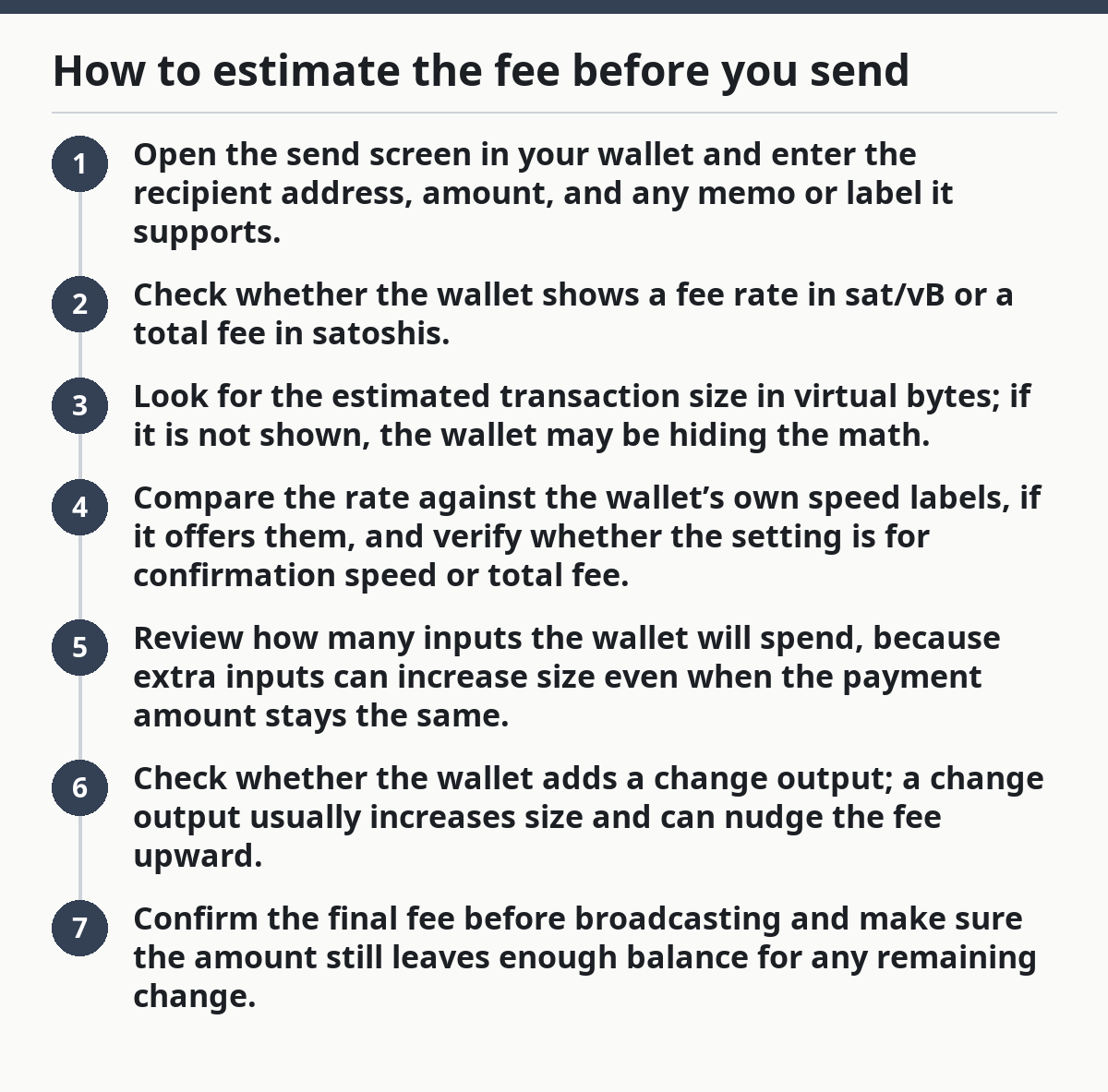
Follow these steps:
- Open the send screen in your wallet and enter the recipient address, amount, and any memo or label it supports.
- Check whether the wallet shows a fee rate in sat/vB or a total fee in satoshis.
- Look for the estimated transaction size in virtual bytes; if it is not shown, the wallet may be hiding the math.
- Compare the rate against the wallet’s own speed labels, if it offers them, and verify whether the setting is for confirmation speed or total fee.
- Review how many inputs the wallet will spend, because extra inputs can increase size even when the payment amount stays the same.
- Check whether the wallet adds a change output; a change output usually increases size and can nudge the fee upward.
- Confirm the final fee before broadcasting and make sure the amount still leaves enough balance for any remaining change.
No fee estimate at all? That is a warning sign. It may be using a very basic fee model, and you should pause until you understand how it calculates the final cost.
What a slow or fast confirmation really means
A higher fee usually improves your odds of faster confirmation, but it does not buy a fixed time slot. Bitcoin confirmations depend on block space, mempool pressure, and the rate miners are accepting at the moment.
A low-fee payment may confirm later, after the mempool clears, without any manual action from you. On the other hand, a high fee may still wait if network demand jumps after you broadcast. Bitcoin is probabilistic, not scheduled.
The best part is that you do not need to guess the future perfectly. You only need a fee that fits your timing need and the wallet’s estimate. The wrong move is assuming one fee setting works the same way every day.
- Higher fee rate: usually better for faster inclusion.
- Lower fee rate: may save money, but can wait longer.
- Fee rate changes: the same wallet setting can behave differently on a busy day.
- Confirmation speed: is a probability, not a promise.
What people confuse a bitcoin transaction fee with
A bitcoin transaction fee is often mixed up with exchange fees, network fees, or the spread on a trading platform, and those are not the same thing. The fee in Bitcoin’s network pays for block space; the others are charges set by a business.
You may see one line for a withdrawal charge and another line for the network fee. The business fee may be fixed or variable, while the bitcoin network fee changes with transaction size and mempool demand. A platform can also charge its own service fee on top.
Common mix-ups include:
- Exchange withdrawal fee: charged by the platform.
- Network fee: paid to miners for block inclusion.
- Wallet service fee: some apps add their own charge.
- Sending amount: the bitcoin moved to the other address, which is separate from the fee.
If you use wallets and exchanges often, the hub on Crypto exchanges and wallet operations can help you place the fee in the bigger picture without mixing up the parts.
When the standard fee explanation does not apply
The usual “set a fee and send” model does not fit every case. Some wallets use advanced coin control, some exchanges batch withdrawals, and some transactions are so large in virtual bytes that they need special attention.
If you are sending from a wallet that has many small deposits, or your transaction includes multiple recipients, the fee math still works the same way. The size can climb fast, though, and a basic “low/medium/high” setting may hide more detail than you want. Large transactions deserve more attention.
Use a more careful approach when:
- You have many small inputs: the transaction may become larger and cost more.
- You are sending to multiple outputs: each extra output raises size.
- Your wallet uses batching: the fee may be shared across several payments.
- Your wallet supports RBF or CPFP: advanced fee tools can change how a slow payment is handled, but those are separate from the fee itself.
- You are dealing with a platform withdrawal: the platform’s stated charge may not match the network fee you’d see in a self-custody wallet.
The mistakes people make with Bitcoin fees
A bitcoin transaction fee mistake usually comes from confusing the rate with the total, or from ignoring transaction size. Small errors can lead to overpaying, waiting longer than expected, or misreading the wallet screen.
You may think the bitcoin amount is all that matters, then the wallet adds more inputs than you expected. The final fee jumps because the transaction is larger, not because the value sent changed. That is a common trap.
Here are the big ones:
- Watching only the total fee: the consequence is you miss whether the rate is competitive; the better alternative is checking sat/vB.
- Ignoring input count: the consequence is a larger-than-expected fee; the better alternative is consolidating only when it fits your wallet setup.
- Confusing platform fees with network fees: the consequence is bad comparisons; the better alternative is reading each line separately.
- Using a fee that’s too low for the mempool: the consequence is slower confirmation; the better alternative is checking the wallet’s current estimate.
- Assuming all wallets calculate fees the same way: the consequence is surprise costs; the better alternative is reviewing the wallet’s fee screen before sending.
Why bitcoin fees change
Bitcoin fees change because the number of people competing for block space changes, and the mempool tells you that demand is moving. More waiting transactions usually means higher fee pressure; fewer waiting transactions usually means less.
Open your wallet on a quiet day, and you may see a modest fee estimate. Later, during a busier period, the same type of transaction may need a higher rate to get the same level of attention from miners. The fee is a market price, not a fixed ticket price. In 2024, mempool pressure on busy days still pushed estimates higher in many wallets.
That is why no single fee number is universal. Rates, wallet defaults, and confirmation targets differ by platform and can shift often. When payment timing or cash handling has wider financial consequences, a qualified adviser can help with the bigger decision.
FAQ
Why do bitcoin fees change?
Bitcoin fees change because block space is limited and demand for that space moves up and down. When the mempool is crowded, users often raise their sat/vB rate to compete for confirmation. When traffic is lighter, lower rates can work. Wallet defaults also vary, so the number you see depends on both network conditions and the wallet’s estimate.
Who gets the fee?
The fee goes to the miner who includes the transaction in a block. It is not paid to the recipient, and it is not the same as a wallet app’s own service charge. If you use an exchange, that platform may also charge its own withdrawal fee, which is separate from the Bitcoin network fee.
How can I estimate the fee before sending?
You can estimate the fee by checking the wallet’s fee rate in sat/vB and its estimated virtual size before you broadcast. Multiply the rate by the size to get the rough total, or use the wallet’s own estimate if it provides one. If the wallet does not show either figure, that is a sign to pause and review its fee settings first.
Drafted with AI; not yet reviewed by a person.