Last updated: November 19, 2026
Quick Answer: 1 key rule. In Seed phrase vs wallet address: what can each one do?, the wallet address is for receiving and public viewing, while the seed phrase is for recovery and control. A wallet address can receive crypto and show public balances; a seed phrase can recover the wallet and control the funds. If you need help deciding how to handle either one, consult a qualified crypto security professional or wallet provider and follow the wallet’s official documentation, such as Ledger’s seed phrase guide and Trezor’s recovery seed support.
A wallet address can receive crypto and show public balances; a seed phrase can recover the wallet and control the funds. In Seed phrase vs wallet address: what can each one do?, the table below settles which one you can share, which one you must guard, and where beginners get burned.
Key takeaways
- A wallet address is for receiving and checking public activity.
- A seed phrase is for recovery access and full control of the wallet.
- A wallet address is not enough to move funds by itself.
- A seed phrase is not something you hand out to get paid.
- If you want a plain-language background on how wallets work, the hub on what is a seed phrase is the right next stop.
The real difference between a seed phrase and a wallet address
A seed phrase is the master backup; a wallet address is the public mailbox. If you only need someone to send you crypto, the address is the thing to share. If you need to rebuild access to a wallet after a lost phone or broken device, the seed phrase is the thing that matters. According to Ethereum.org, wallets use keys for access, and recovery phrases are the backup path.
Here’s the catch: they do not do the same job at all. A wallet address is usually derived from a public key, and it is designed to be seen. A seed phrase sits on the private side of the wallet and should stay off public channels.
| Criteria | Seed phrase | Wallet address | Winner for this condition |
|---|---|---|---|
| Main job | Restores wallet access | Receives funds | Depends on the task |
| Visibility | Private | Public | Wallet address for sharing |
| Can receive crypto | No | Yes | Wallet address |
| Can send or move funds | Yes, through wallet recovery | No | Seed phrase |
| Can show balances and history | Not by itself | Yes, on a block explorer | Wallet address |
| Should be shared in chat or email | Never | Often, if you want payment | Wallet address |
| Can prove ownership | Yes, by restoring the wallet | No, not on its own | Seed phrase |
| Risk if exposed | Very high | Lower, but not zero | Wallet address is safer to share |
| Best mental model | Backup key | Public account number | Tie, by use case |
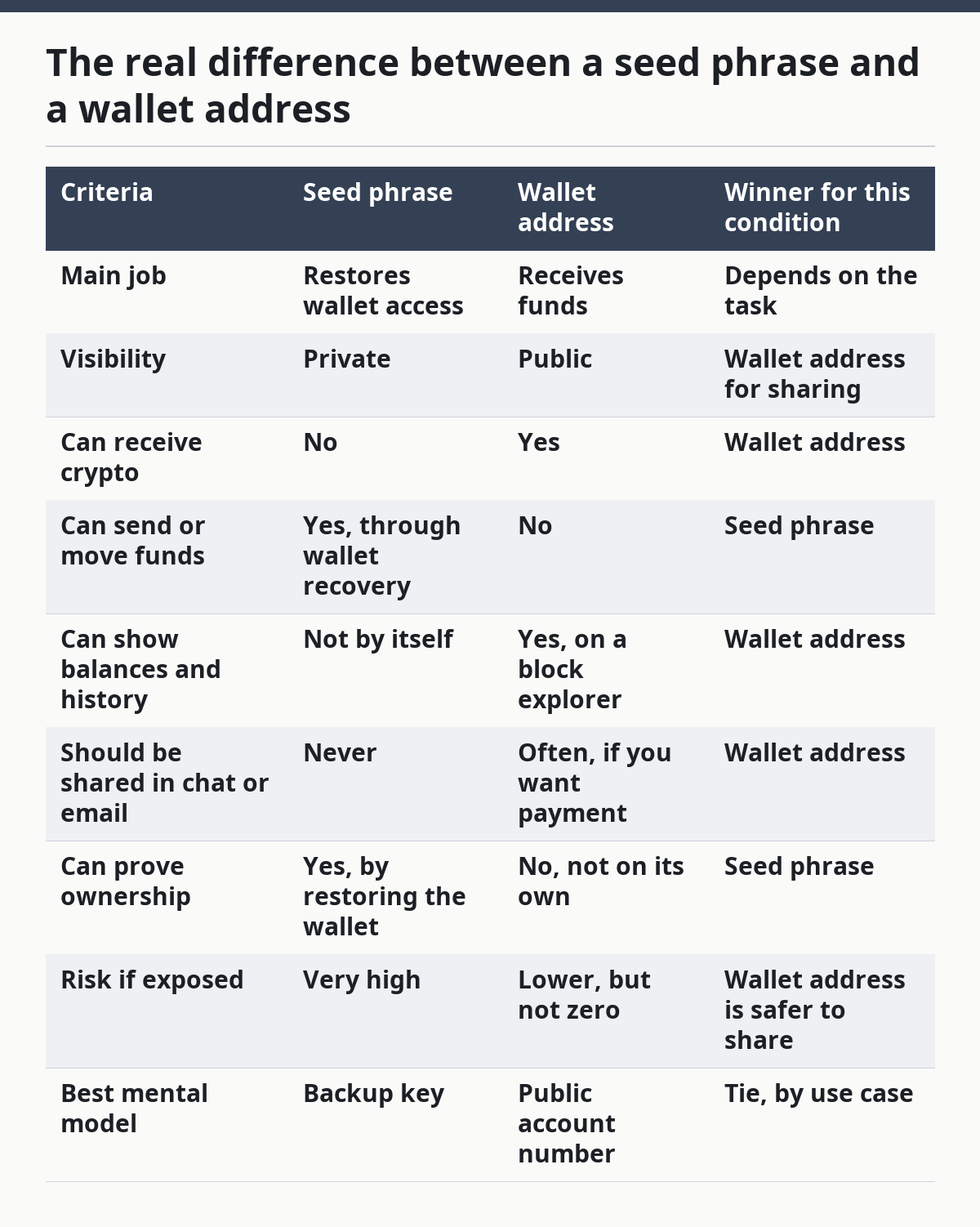
The first mistake is treating the address like a secret. It is not. The second mistake is treating the seed phrase like a payment detail. If you are unsure, consult the wallet’s support materials or a qualified professional before sharing anything.
What a wallet address can do — and what it cannot
A wallet address is enough to receive crypto and let other people see the destination, but it cannot recover the wallet or prove you are the owner. Picture this: you are sending a friend your payment details, and you want them to copy one string into their app without giving them the keys to the account. In Chainalysis’s 2024 Crypto Crime Report, on-chain tracing is a core feature of blockchain analysis, which is why addresses are often used to inspect transfers.
That is exactly the role of a wallet address. It is public information. In many wallets, the address can also be used to look up transfers on a block explorer, which is why people call it “view-only data.”
- It can be pasted into a payment form.
- It can be searched to inspect incoming and outgoing transfers.
- It cannot restore a wallet after loss of access.
There’s a limit, though. A wallet address does not let someone spend your funds unless they also have the signing access behind the wallet. So the address is useful, but only in a narrow lane. If you are paying bills, requesting donations, or letting an exchange send a withdrawal, the address is the right thing to hand over.
What a seed phrase can do — and why it is not a payment detail
A seed phrase can restore a wallet and recreate the keys behind it, which is why it is the most sensitive piece of the setup. Picture this: you are setting up a new phone, and the wallet app asks for the backup words so it can rebuild access without the old device. The Bitcoin Improvement Proposal that defines hierarchical deterministic wallets is BIP-39, which is the standard many wallets build on.
That is the seed phrase’s job. It is recovery access, not a public identifier. In most crypto wallets, those words are enough to recreate the same wallet structure on another device, including the addresses derived from it.
- It can bring a wallet back after device loss.
- It can recreate access in a compatible wallet app.
- It can control funds if someone else gets it.
- It should not be typed into random websites, support chats, or forms.
The downside is severe. A seed phrase is not something you can “partially share” and still stay safe. If someone gets the full phrase, they can usually recreate the wallet. If you are uncertain about sharing it, consult the wallet provider or a security professional first. That is why the practical rule is simple: the address is for receiving; the seed phrase is for recovery; they are not interchangeable.
Is a wallet address private?
A wallet address is public information, but it is not harmless in every case. Picture this: you are posting a payment address on a checkout page, in a donation link, or in a support ticket. You want the other party to see it, and you want it to work across wallets and explorers.
That is normal. A wallet address is meant to be visible. What it does not reveal by itself is the seed phrase or the private signing material behind the wallet.
The trade-off is privacy, not access.
- Anyone can usually see the address on-chain.
- Anyone can track that address’s transfers if they look it up.
- An address does not usually tell strangers your name, but repeated use can still link activity together.
- A fresh address for a new payment can reduce easy linking, depending on the wallet and chain.
So the answer is not “hide the address at all costs.” It is “treat the address as public data and the seed phrase as secret recovery data.” If the situation is sensitive, consult official wallet guidance before you share either one.
The honest side-by-side: which one wins for each job?
The seed phrase wins for control, while the wallet address wins for sharing. Picture this: you are comparing two strings that look similar at a glance, but one is meant to be posted and the other is meant to be locked away.
That difference matters because the wrong choice causes the wrong failure. Share a wallet address when you want to get paid. Share a seed phrase and you may hand over the wallet itself.
| Question | Seed phrase | Wallet address | Winner for this condition |
|---|---|---|---|
| Can I use this to receive crypto? | No | Yes | Wallet address |
| Can I use this to restore access? | Yes | No | Seed phrase |
| Can other people see it safely? | No | Yes | Wallet address |
| Does it expose control of funds? | Yes, if leaked | No, by itself | Wallet address |
| Is it useful for support tickets? | No | Sometimes, if only a receiving address is needed | Wallet address |
| Is it useful after a lost phone? | Yes | No | Seed phrase |
| Should it be stored offline? | Yes | Not necessary in the same way | Seed phrase |
| Can it be re-used across payments? | No | Yes, though reuse has privacy costs | Wallet address |
The pattern is clean. A wallet address is the public face of the wallet; the seed phrase is the recovery engine behind it. If you remember only one sentence, make it this: share the address, protect the phrase.
Which one should you actually use?
Choose the wallet address if you need to receive crypto, post a payment destination, or show a balance without giving access. Choose the seed phrase if you need to restore a wallet on a new device or back up the recovery path. Neither if you are trying to confirm a recovery method with a support agent or a stranger in chat.
Picture this: you are about to send one string to someone else and you are not sure which string belongs in the message. The safer default is the address, because it is meant to be public. The seed phrase is the one that stays out of the conversation.
Here is the practical rule I give beginners: if the other person needs to send you funds, they need the wallet address. If you need to get your wallet back, you need the seed phrase. If you are unsure which one a form is asking for, stop and read the prompt again before you paste anything.
One more thing. A wallet address is not a secret, but it still deserves care. A seed phrase is not a convenience shortcut, and it should never be treated like one. If the form or chat looks unclear, consult the provider before entering either string.
When the answer flips
The seed phrase wins in some rare cases where the address seems more useful at first glance. Picture this: you are dealing with a lost device, a wiped app, or a new wallet app that asks you to import an existing wallet.
That is the moment the address stops helping. The address can show you the wallet, but it cannot rebuild it.
- If the problem is recovery, the seed phrase matters.
- If the problem is receiving funds, the wallet address matters.
- If the goal is public verification, the address matters.
- If the goal is control, the seed phrase matters.
There is one more flip worth naming. If you are trying to prove that a wallet belongs to you, the address alone is weak evidence. The stronger proof is the ability to restore or sign from the wallet itself, which is why the seed phrase sits at the center of recovery.
The bottom line for beginners
The wallet address is for public receiving and the seed phrase is for private recovery. If you mix them up, you either block a payment or hand over control of the wallet.
The clean rule is simple. Use the wallet address when someone needs to send crypto to you. Keep the seed phrase off shared channels because it can restore the wallet itself. If you want the deeper background on how the backup side works, the hub on what is a seed phrase fills in the larger picture.
Can someone send crypto with just my address?
Yes. A wallet address is enough for someone to send crypto to you, as long as they use the right network and the right asset. The address is the public receiving detail. It does not let them spend your funds or recover your wallet by itself.
Can I recover a wallet from an address?
No. A wallet address does not give recovery access. It can show public activity and receive funds, but it cannot rebuild the wallet or replace the seed phrase. If the wallet app is gone and the backup words are gone too, the address alone will not restore control.
Is a wallet address private?
No. A wallet address is public information by design. You can share it to get paid, and other people can often inspect its on-chain activity. The privacy risk is usually about visibility and linking, not direct wallet control.
Drafted with AI; not yet reviewed by a person.