Last updated: November 19, 2026
Key Takeaways
- Without a complete seed phrase, restoring a non-custodial wallet is usually not possible.
- If someone gets the phrase, they can usually move the wallet’s assets.
- Non-custodial wallets have limited recovery because no support team can reset access.
- Act fast if the wallet is open, the phrase is exposed, or a device session is still signed in.
If you lose a seed phrase, What happens if a seed phrase is lost or stolen? Often, you may lose access to the wallet forever; if someone steals it, they can usually drain a non-custodial wallet without needing your phone or password. The sections below explain what still works, what fails, and where recovery stops.
What a lost seed phrase means for your wallet
A lost seed phrase usually means the wallet cannot be restored on a new device, because the seed phrase is the backup that recreates the private key. If the wallet is a non-custodial wallet, no company holds a spare copy for you.
That sounds harsh because it is.
The practical result depends on one detail: do you still have the wallet open on a device, or did the only copy of the seed phrase disappear? If the wallet app is still logged in on a phone or laptop, you may still be able to move funds. If the device is gone too, the seed phrase may be the only recovery path.
A seed phrase is not the wallet itself. It is the master key that can regenerate the private key tied to that wallet. Lose the phrase, and the chain of control can break even if the coins are still on-chain.
- If the wallet still opens, the funds may still be reachable.
- If the app is wiped, restored, or lost, access can end there.
- If the wallet was custodial, a separate recovery process may exist.
This page is about non-custodial wallets.
For the plain-language version of what a seed phrase is, the hub page on what is a seed phrase covers the basic terms without the panic.
What happens if someone steals your seed phrase?
Someone with your seed phrase can usually take control of the wallet and move the assets. In a non-custodial wallet, the seed phrase is enough to rebuild the private key and sign transactions.
That is why theft is worse than a lost backup. A lost phrase is a lockout. A stolen phrase is an active break-in.
Picture this: you still see the balance in the app, but a thief has already copied the 12-word or 24-word phrase. They don’t need your PIN if they can import the wallet elsewhere. They can often sweep tokens, coins, and any other assets tied to that same wallet address.
Two details matter here:
- The thief does not need your old device.
- The thief does not need your permission.
If the seed phrase was exposed, speed matters more than debate. Move what you can from the compromised wallet to a fresh wallet with a new seed phrase. If there are multiple wallets under one phrase, consult a qualified wallet security professional and check a current source before assuming they are all exposed, because they share the same root secret.
One catch: moving funds only helps if you still control the wallet long enough to sign the transfer. Once the thief moves the assets first, the loss is usually final. That is the hard edge of non-custodial design.
Why non-custodial wallets have hard recovery limits
Non-custodial wallets have hard recovery limits because there is no central account team to reset your access. The wallet software can help you use the seed phrase, but it cannot replace it on demand.
A crypto exchange account and a non-custodial wallet are not the same thing. With an exchange, the company may verify identity and reset access. With a non-custodial wallet, the system is built so only the private key holder can sign transactions.
Here’s the catch: that design protects you from a third party controlling your funds, but it also means the wallet provider cannot usually help if the seed phrase disappears. There is no back door that a support agent can open without breaking the security model.
A few consequences follow:
- No seed phrase, no easy restore to a new device.
- No seed phrase, no proof that you own the wallet in a way the network can read.
- No seed phrase, no standard “forgot password” reset for the blockchain itself.
That is why a backup copy matters so much. A paper note, a metal backup, or any other offline record is not a convenience; it is the thing standing between access and permanent lockout.
The limits are especially stark for older wallets or forgotten wallets with no logged-in device left. If the seed phrase was never copied correctly, or all copies were destroyed, the chain of recovery may end there. The software cannot invent a new phrase that opens the old one.
What you can still do right away
You can still act fast if the wallet is open, the seed phrase is exposed, or you have a device session still logged in. The goal is to reduce damage in the first 10 to 30 minutes, not to “fix” the lost phrase.
- Check whether the wallet is still accessible on any device. Open the app on your phone, tablet, or laptop and see whether it still shows the balance. If it does, you may still be able to move assets before the wallet is lost for good.
- Create a new wallet with a fresh seed phrase. Use a clean setup and generate a new backup, not a reused one. The result you want is a wallet that is not tied to the compromised phrase.
- Move assets out of the old wallet. Send coins and tokens to the new wallet address. The transfer proves you still control the old wallet while it is alive.
- Review connected approvals where possible. Some tokens and apps use permissions that can keep working after exposure. Clearing those approvals can reduce extra loss.
- Check every wallet tied to the same seed phrase. One exposed phrase can cover more than one account, depending on the wallet setup. Consult a qualified wallet security professional and verify the wallet’s documentation before assuming they are linked.
If the seed phrase is only lost, the urgent task is finding the backup copy before the wallet becomes inaccessible. If the seed phrase is stolen, the urgent task is moving funds before the thief does.
A public blockchain does not wait for a support ticket.
Common mistakes that make a bad situation worse
Common mistakes turn a recoverable scare into a permanent loss. The worst one is entering the seed phrase into a website or fake app that claims it can “check” or “restore” the wallet.
That is a theft trap.
Other mistakes are less dramatic but still expensive:
- Waiting too long to move funds. In a stolen-phrase case, delay gives the thief time to sweep the wallet.
- Assuming a screenshot counts as a backup. Screenshots sit on devices, cloud sync systems, and photo libraries that can be copied or breached.
- Mixing old and new wallets. Reusing the same seed phrase or restoring it on multiple devices keeps the same risk alive.
- Ignoring smaller assets. A compromised phrase can expose dust balances, NFTs, or token approvals, not just the main coin balance.
The trade-off is simple: convenience makes wallets easier to use, but it also makes bad backups easier to forget. A seed phrase written once and left vague in a notes app is not much better than no backup at all.
If you have multiple copies, check whether they are all readable and complete. One missing word, one wrong order, or one unreadable line can make the whole phrase useless. That is why backup copies need a clear format and a known storage place.
For a technical standard reference, BIP-39 from the Bitcoin Improvement Proposals family is the common wording standard behind many mnemonic seed phrases. Not every wallet uses it exactly the same way, but it is the term many wallet docs use.
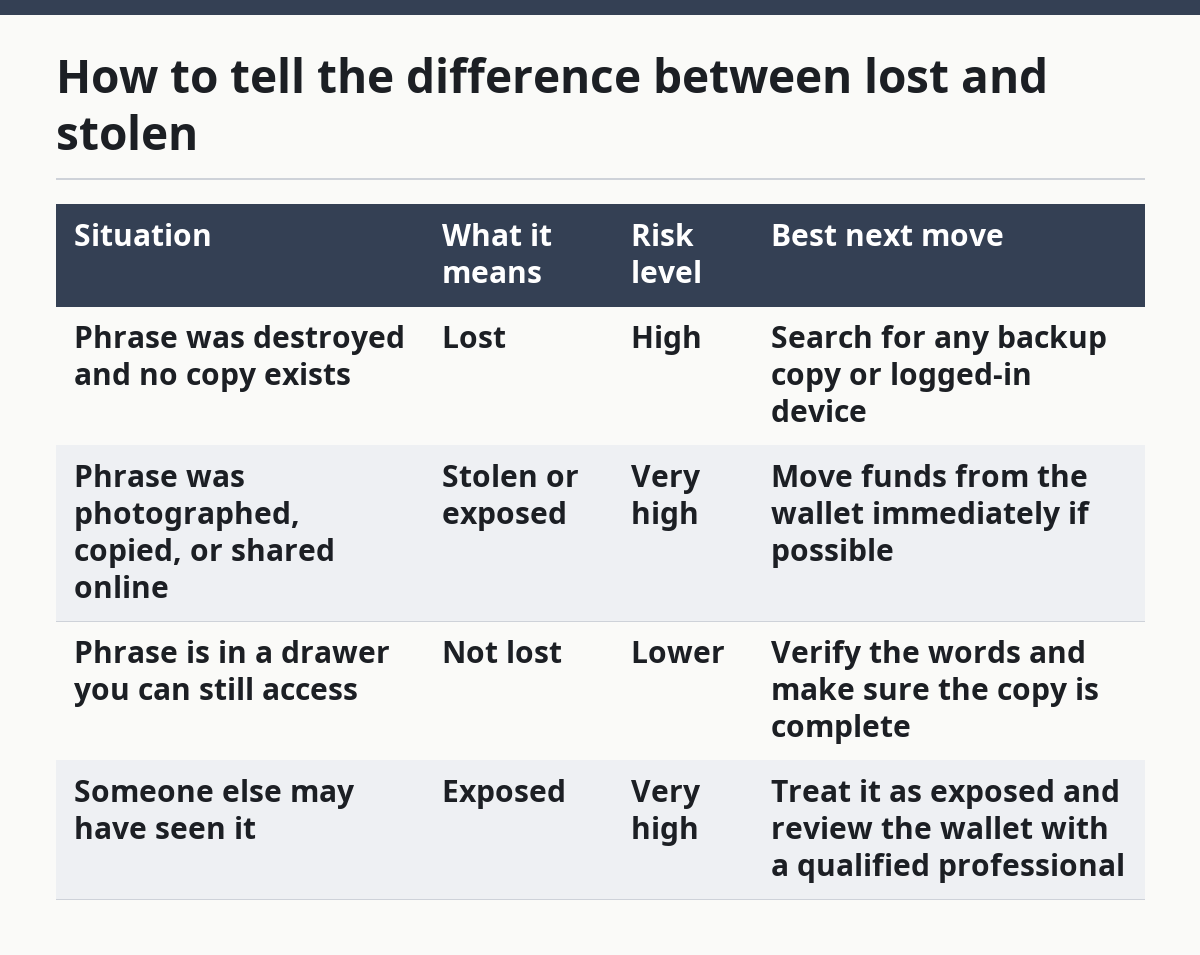
How to tell the difference between lost and stolen
You can tell the difference by looking at control, not just location. A seed phrase is lost when you no longer know where any usable copy is. It is stolen when someone else can likely read or use it.
That distinction matters because the risk changes fast. Lost usually means lockout. Stolen means immediate exposure.
Use this quick check:
| Situation | What it means | Risk level | Best next move |
|---|---|---|---|
| Phrase was destroyed and no copy exists | Lost | High | Search for any backup copy or logged-in device |
| Phrase was photographed, copied, or shared online | Stolen or exposed | Very high | Move funds from the wallet immediately if possible |
| Phrase is in a drawer you can still access | Not lost | Lower | Verify the words and make sure the copy is complete |
| Someone else may have seen it | Exposed | Very high | Treat it as exposed and review the wallet with a qualified professional |
A stolen phrase is not only a privacy issue. It is a signing key issue. Whoever has it can act like the wallet owner from the network’s point of view.
That is why “I only showed it to one person” is not a safe middle ground. One copy in the wrong hands is enough.
What a backup copy changes
A backup copy changes everything if it is complete, accurate, and accessible to you. It does not protect you from theft after exposure, but it can save you from permanent lockout when the original is gone.
Picture this: you lose a phone, panic, and think the wallet is gone with it. If a correct seed phrase copy exists offline, the wallet is usually still recoverable on a fresh device. If no copy exists, the wallet may be unrecoverable even though the blockchain records still show the funds.
That is why backup copies are not all equal:
- A complete backup has every word in the right order.
- A legible backup can still be read months or years later.
- An offline backup is less exposed to cloud theft or malware.
- A known-location backup is the one you can actually find under pressure.
The catch is that backups can fail too. Paper burns. Metal can be misplaced. A note hidden “somewhere safe” can become impossible to find when you need it. So the real problem is not just making a backup; it is making one you can recover under stress.
If the phrase is stolen, a backup copy helps only if you act before the thief drains the wallet. If the phrase is lost, the backup copy may be the only thing that still stands between you and a dead wallet.
The practical bottom line for lost or stolen seed phrases
A lost seed phrase can lock you out of a non-custodial wallet, and a stolen seed phrase can let someone else control it. The wallet itself does not know the difference; it only knows who can sign with the private key.
That is the whole story in one line.
If you still have an open session, move fast. If the phrase is only lost, look for the backup copy. If it is stolen, treat the wallet as exposed and assume the thief can act without warning. The network will not pause for you, and support may not be able to reverse anything.
The best protection is to keep a reliable offline backup before trouble starts. A seed phrase is the recovery key, not a receipt. Lose it, and access can vanish. Lose control of it, and the wallet can be stripped clean.
Can a wallet be recovered without a seed phrase?
Usually, no. A non-custodial wallet normally cannot be restored without the seed phrase because the phrase is what recreates the private key. If the wallet provider is a custodian or the account is tied to a separate login system, recovery may follow a different path, but that is a different setup.
What if someone else gets my seed phrase?
If someone else gets your seed phrase, they can usually control the wallet. They do not need your device or your password if the wallet is non-custodial. If you still have access, move funds to a fresh wallet as soon as you can.
Is a seed phrase recoverable?
No, not by the blockchain or the wallet itself. The phrase is the backup secret, and if it is gone with no copy left, it is usually gone for good. A wallet app may help import it if you already have it, but it cannot invent the missing words.
Drafted with AI; not yet reviewed by a person.