Last updated: November 19, 2026
Quick Answer: 2 core layers. Blockchain and network fundamentals come down to two layers: the ledger layer that orders history, and the network layer that moves messages across nodes. In Blockchain and Network Fundamentals: The Complete Guide, those two layers explain why a distributed system can agree on records without a central owner.
In short: blockchain is a way to have many computers agree on the same record without a central owner, and network fundamentals explain how those computers find each other, exchange data, and survive failures. If you understand nodes, consensus, hashes, blocks, and peer-to-peer communication, the rest of blockchain stops looking like magic and starts looking like engineering. Blockchain and network fundamentals are easiest to understand when you keep the ledger and the network separate in your mind.
Key takeaways
- A blockchain is not “the internet’s database”; it is a shared ledger that only works because a network of nodes follows the same rules.
- The network matters as much as the chain itself. If peers cannot discover each other, relay messages, and validate data, the blockchain stalls.
- The three ideas that do most of the work are cryptographic hashes, consensus rules, and distributed networking.
- Public blockchains trade speed and finality for openness; permissioned systems trade openness for control and simpler governance.
- The right mental model is “many machines, one agreed history,” not “one giant cloud app.”
If you want the cleanest possible mental model, start here: blockchain is a coordination system built on top of a computer network. The blockchain part stores ordered history; the network part moves messages and enforces rules across many independent nodes. That distinction matters because most beginner confusion comes from mixing them together in Blockchain and Network Fundamentals: The Complete Guide.
What a blockchain actually is
A blockchain is a ledger made of blocks, where each block points to the one before it using a cryptographic hash. That link is what makes the chain tamper-evident: if one old block changes, its hash changes, and every later block no longer fits.
The simplest useful analogy is a shared notebook where every page includes the fingerprint of the page before it. You can still write new pages, but you cannot quietly rewrite page 12 without breaking page 13, 14, and everything after them. That is the core property, not “digital money” and not “decentralization” by itself.
A block usually contains three things: transaction data, a timestamp or ordering signal, and metadata that helps the network validate it. On proof-of-work chains such as Bitcoin, the block header also includes a nonce and a difficulty target. On proof-of-stake systems, the block proposal and validation process are different, but the chain still depends on cryptographic linking and shared rules.
This is where many generic explanations go wrong: they treat blockchain as if the chain itself guarantees truth. It does not. The chain only guarantees that the network can detect edits and agree on one history under the system’s rules. If those rules are weak, the chain can still record bad data faithfully. If you are making a high-stakes decision, consult a qualified blockchain or security professional and verify the protocol assumptions against authoritative documentation such as the Bitcoin Developer Documentation: https://developer.bitcoin.org/ and the Ethereum.org developer documentation: https://ethereum.org/en/developers/docs/.
A second common mistake is to assume “decentralized” means “no one is in charge.” In practice, every blockchain has rules, software clients, economic incentives, and social governance. Someone chooses the protocol, upgrades the code, and resolves disputes. The difference is that no single party can rewrite the ledger at will.
For a beginner, the most important thing to remember is this: blockchain is a database design pattern plus a trust model. It is useful when several parties need a record, but no single party should own the record outright.
How the network underneath a blockchain works
A blockchain network is usually a peer-to-peer network, not a client-server app. That means nodes communicate directly with one another instead of sending everything through one central server. This matters because resilience comes from redundancy: if one node disappears, the rest keep the system alive.
A node is any computer running blockchain software. Some nodes keep the full history, some prune old data, some validate transactions, and some only broadcast messages. On Bitcoin, for example, a full node verifies the rules independently; a lightweight wallet may rely on other nodes for parts of the data. On Ethereum, the client software and execution layer have their own networking and validation responsibilities.
The network needs three basic functions:
- Discovery — nodes find peers to connect to.
- Propagation — nodes relay transactions and blocks.
- Validation — nodes check whether incoming data follows the protocol.
That sounds simple, but each part is a failure point. If discovery is slow, the network feels isolated. If propagation is poor, miners or validators work on stale information. If validation is inconsistent, different nodes disagree about the state of the ledger.
Network fundamentals also explain why blockchains have latency. A transaction does not become globally accepted the instant it is signed. It must travel through the network, be checked, possibly sit in a mempool, then be included in a block, then survive enough confirmations or finality conditions to become hard to reverse. The exact timing depends on the chain’s consensus design.
This is also where bandwidth, latency, and node geography matter. A node in one region may hear about a block a fraction of a second earlier than another node far away. That tiny delay can affect mining races, fork choice, and how often temporary disagreements appear.
The generic mistake here is to talk about “the blockchain” as if it were one computer. It is not. It is a set of software rules running on many computers connected by a network, and the network’s quality directly shapes the chain’s behavior.
Why hashes, signatures, and Merkle trees matter
Hashes are the integrity layer of blockchain. A hash takes input data and produces a fixed-length output that changes drastically if the input changes even a little. A good cryptographic hash is one-way enough that you cannot realistically reverse it to recover the original input, and collision-resistant enough that two different inputs should not produce the same output in practical use.
Digital signatures solve a different problem: they prove that a transaction was authorized by the holder of a private key. The network can verify the signature with the corresponding public key, without learning the private key itself. That is what lets blockchain systems work without asking a bank or platform to confirm identity for every transfer.
Merkle trees help the network verify lots of data efficiently. Instead of storing one hash for every transaction at the top level, the chain stores a root hash that summarizes a whole set of transactions. That lets a node prove that one transaction belongs in a block without downloading every transaction in the block.
These three tools work together. Hashes protect the chain structure, signatures protect ownership and authorization, and Merkle trees make verification scalable. Remove any one of them and the system gets weaker fast.
A beginner-friendly way to think about it:
- Hashes answer, “Has this data changed?”
- Signatures answer, “Did the owner approve this?”
- Merkle trees answer, “Can I prove inclusion without carrying the whole block?”
A generic article often leaves out the operational reason these matter. They are not decorative cryptography. They are the reason a distributed network can agree on data without trusting a central clerk.
There is one honest limitation to state plainly: cryptography does not make bad inputs good. If someone signs a fraudulent transaction, the network may still accept it as valid because the signature is technically correct. Blockchain protects integrity and authorization, not truth in the human sense.
Consensus is the rulebook that keeps the chain from splitting
Consensus is how a network chooses one valid history when many nodes can see events in different orders. This is the real engine of blockchain systems, and it is where the biggest trade-offs live.
The two best-known consensus families are proof of work and proof of stake.
Proof of work uses computational effort to make block creation costly. Miners compete to solve a puzzle, and the winner proposes the next block. Bitcoin uses this model. Its strength is simple: attacking the chain requires large, ongoing energy and hardware cost. Its weakness is equally clear: it is resource-intensive and tends to process fewer transactions per second than a centralized database.
Proof of stake uses locked capital rather than raw computation as the main security input. Validators put assets at risk, and protocol rules can penalize dishonest behavior. Ethereum uses proof of stake after its move away from proof of work. The strength here is lower energy use and faster coordination on many designs; the weakness is a more complex validator and slashing model, plus governance questions around who controls staking infrastructure.
Consensus also determines finality. Some chains, especially proof-of-work systems, reach probabilistic finality: the more blocks added after a transaction, the less likely it is to be reversed. Other chains offer stronger, protocol-level finality once a block is finalized by the validator set. That difference is not academic. It affects exchanges, settlement systems, bridges, and any application that cannot tolerate reversals.
The generic mistake is to treat consensus as a single feature. It is not. Consensus affects security, speed, energy use, governance, and user confidence all at once. If you are choosing a protocol, consult a qualified blockchain or security professional and compare the system to the consensus rules described in the Bitcoin Developer Documentation and the Ethereum.org developer documentation.
For a reader choosing a chain or building on one, the real question is not “Which consensus is best?” It is “Which failure mode can I live with?” If you need deep battle-tested security and can accept slower settlement, proof of work has a strong case. If you need faster finality and lower operational energy, proof of stake may fit better, but the validator assumptions need closer scrutiny.
Public chains vs permissioned networks: which model fits the job?
Public chains win when openness matters more than control. Permissioned networks win when a known group needs privacy, governance, or compliance controls.
A public blockchain lets anyone read the chain, submit transactions, and often run a node. Bitcoin and Ethereum are the clearest examples. The benefit is broad participation and censorship resistance. The cost is that performance, privacy, and governance are harder to manage because the network must remain open to strangers.
A permissioned blockchain restricts participation to approved entities. That can mean a consortium of banks, a supply chain group, or an enterprise network with access controls. The benefit is simpler governance, tighter privacy, and easier policy enforcement. The cost is that trust shifts back toward the permissioning body, and the system can begin to resemble a shared database more than a fully open blockchain.
This is the decision most beginners misunderstand. They hear “blockchain” and assume the public model is automatically better. It is not. If the participants already trust one another, or if one organization can simply run the system centrally, a blockchain may be unnecessary overhead. A conventional database or replicated ledger may be cheaper, faster, and easier to operate.
Here is the practical rule: use a public chain when you need open participation, neutral rules, and external verifiability. Use a permissioned system when the parties are known, legal accountability matters, and the main goal is synchronized recordkeeping across organizations.
One honest drawback of permissioned systems is that they can be harder to justify. If one admin group can update access, stop nodes, and decide upgrades, the “decentralization” value drops sharply. That does not make the design bad. It just means the label should not be used as marketing gloss.
The honest side-by-side
A clear comparison helps because blockchain choices are usually trade-offs, not upgrades. The right answer depends on who must trust the system, how fast transactions must settle, and how much control the operator is willing to keep.
| Criteria | Public blockchain | Permissioned network | Winner for this condition |
|---|---|---|---|
| Who can join | Open participation; rules are public | Approved members only | Public chain for open access |
| Governance | Slower, community-driven upgrades | Faster, committee-led decisions | Permissioned for fast policy changes |
| Security model | Depends on broad validator/miner distribution | Depends on member honesty and access control | Public chain for hostile environments |
| Privacy | Usually low without extra layers | Better native confidentiality | Permissioned for sensitive records |
| Transaction throughput | Often constrained by global consensus | Usually higher because the group is smaller | Permissioned for internal workflows |
| Finality | May be probabilistic or slower | Can be faster and more deterministic | Permissioned for settlement deadlines |
| Resistance to censorship | Stronger if the network is widely distributed | Weaker because operators are known | Public chain for censorship resistance |
| Operational complexity | High, especially for node and fee dynamics | Moderate, with simpler access control | Permissioned for enterprise admin teams |
| Need for a trusted operator | Lower, by design | Higher, by design | Public chain if trust minimization matters |
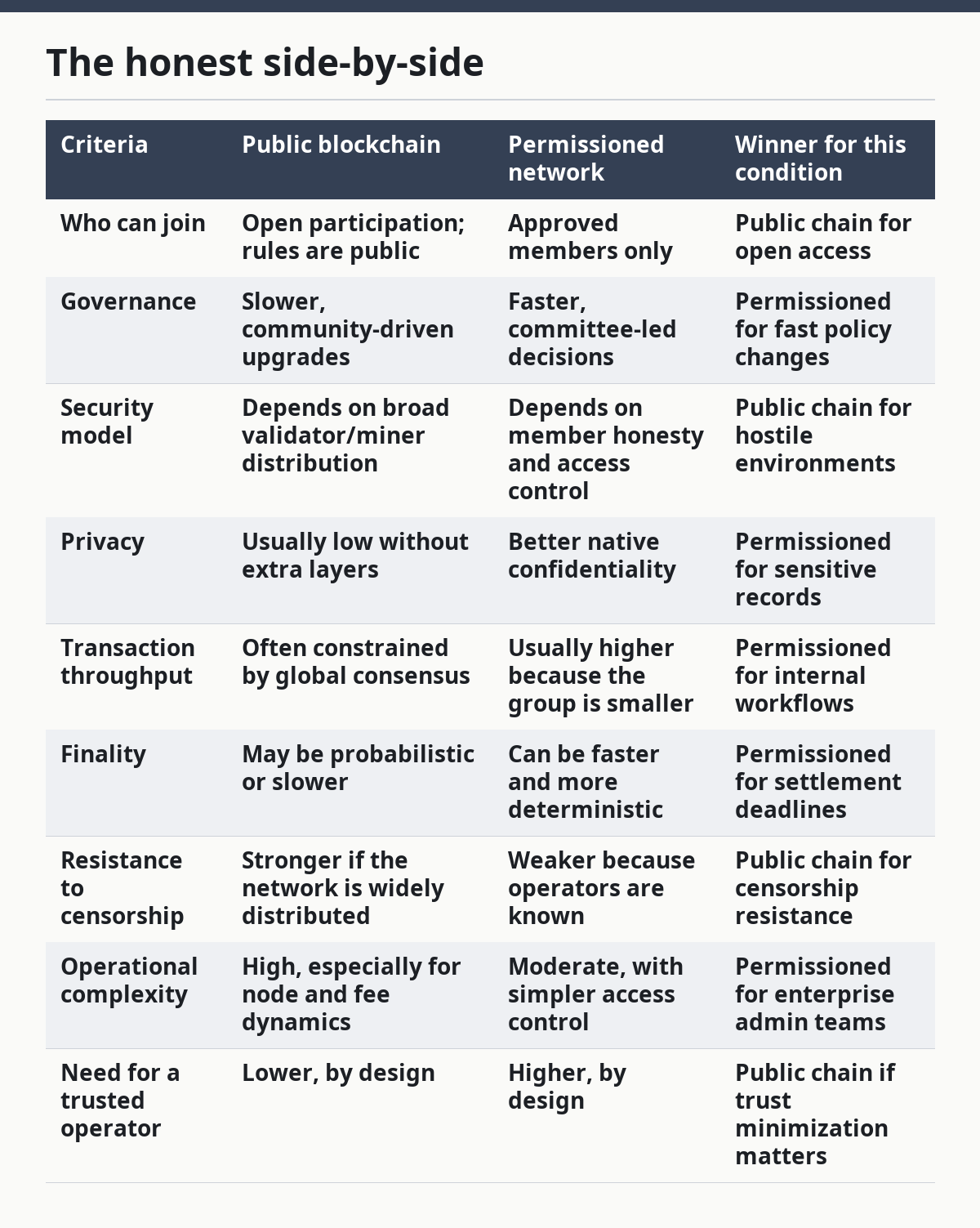
That table points to a hard conclusion: public chains win on openness and censorship resistance, while permissioned systems win on control and organizational fit. What a generic article often misses is that “better” depends on the trust problem. If there is no trust problem to solve, blockchain may not belong in the design at all.
What beginners usually miss about blockchain security
Blockchain security is not one thing. It is a stack of assumptions, and the system fails when any one layer is wrong.
The first layer is key management. If a private key is stolen, the blockchain cannot tell whether the rightful owner signed the transaction or an attacker did. Hardware wallets, multisignature setups, and recovery procedures matter because the network itself cannot fix bad key hygiene.
The second layer is network security. Nodes can be delayed, partitioned, eclipsed, or fed bad peers if the networking layer is weak. An eclipse attack tries to isolate a node from honest peers so it sees a distorted view of the chain. That is a network problem before it becomes a blockchain problem.
The third layer is protocol security. Consensus bugs, client bugs, and poorly designed incentives can create chain splits or let attackers exploit edge cases. A blockchain is only as strong as the software that validates it, which is why multiple client implementations and careful upgrade processes matter.
The fourth layer is economic security. If attacking the chain is cheap relative to the rewards, the protocol becomes fragile. That is why people talk about hashrate, validator stake, slashing, and economic finality instead of only cryptography.
A generic explanation often leaves readers with the false impression that “blockchain is secure by definition.” It is not. It is secure only when identity, networking, consensus, and economics line up. For high-value deployments, consult a qualified security professional and review current guidance from the National Institute of Standards and Technology: https://csrc.nist.gov/.
This is also where the most useful caution belongs: do not confuse immutability with safety. A blockchain can preserve a bad transaction permanently. It can also preserve a software bug, a governance mistake, or a malicious upgrade if the network accepts it. The chain makes history hard to change; it does not guarantee that history is good.
When blockchain is the right tool — and when it is the wrong one
Blockchain wins when multiple independent parties need a shared record and none should get unilateral control. That is the strongest use case, and it is narrower than most marketing suggests.
Good fits include:
- cross-border or cross-organization settlement where no single operator should own the ledger
- asset provenance where auditability matters more than speed
- public coordination systems that need open verification
- programmable money or digital assets that must move without a central processor
- situations where censorship resistance is a core requirement, not a bonus
Bad fits include:
- one company managing its own internal database
- high-frequency workloads that need sub-second updates and simple rollback
- private data stores where a standard access-controlled database is enough
- systems that need confidentiality but do not want the overhead of cryptographic network design
- any problem that becomes more complex just because blockchain is present
The right question is not “Can blockchain solve this?” It is “What trust problem does blockchain solve that a normal database cannot?” If the answer is vague, the design is probably wrong.
That position is important because the tech world still throws blockchain at problems that only need replication, digital signatures, or a clear audit trail. Those can be built without a distributed ledger. A plain database with append-only logs, access controls, and backups is often easier to run and easier to explain.
My recommendation is direct: use blockchain only when decentralization, neutral verification, or resistance to a single point of control is part of the requirement. Use something else when the goal is simply to store and retrieve data reliably.
The specific concepts to learn next
If you want to move from surface knowledge to real competence, there are seven terms worth learning in order. Each one changes how the network behaves.
- Mempool — the pool of unconfirmed transactions waiting to be included in a block.
- Fork — a temporary or permanent split in chain history.
- Confirmation — evidence that a transaction has been accepted by subsequent blocks.
- Finality — the point at which reversal becomes impractical or protocol-forbidden.
- Validator — a node allowed to propose or attest to blocks in a proof-of-stake system.
- Hash rate — the computational power securing a proof-of-work network.
- Slashing — a penalty that removes stake when validators break the rules.
A beginner who understands those seven terms can read most protocol documentation without getting lost. A beginner who skips them usually ends up repeating slogans instead of understanding systems.
One more useful step is to read the primary docs for the systems you care about. The Bitcoin developer documentation and the Ethereum.org documentation both explain protocol mechanics in direct language. For standards on cryptography and networking terminology, the National Institute of Standards and Technology is a reliable reference point for foundational security concepts, and the IEEE publishes widely used networking standards.
That last point matters because this field attracts a lot of confident but shallow explanations. If a source cannot tell you how peers discover one another, how transactions propagate, and what consensus actually guarantees, it is not teaching fundamentals.
The verdict: which model to choose and why
Choose a public blockchain if you need open participation, censorship resistance, and a ledger that no single organization should control. Choose a permissioned network if the participants are known, privacy matters, and the group needs faster governance with clearer operational control. Neither if your problem is just ordinary data storage, because a normal database is cheaper, simpler, and easier to maintain.
That is the clean answer. The rest of the decision depends on trust, not fashion.
What happens if the network gets split?
A network split can create a fork, where two versions of the chain briefly or permanently exist at the same time. In a proof-of-work system, the chain with the most accumulated work usually wins, while the other branch is abandoned or reorganized into the canonical history. In a proof-of-stake system, finality rules and validator behavior often make splits harder to sustain, but they do not make them impossible.
The practical consequence is that network reliability matters as much as cryptographic design. If peer communication degrades, consensus gets slower, confirmations get weaker, and users see more uncertainty. This is why node diversity, client diversity, and healthy propagation are not niche concerns; they are core infrastructure.
A reader should also know that not every fork is a disaster. Some are planned upgrades, like protocol hard forks, and others are temporary coordination artifacts. The risk is uncontrolled divergence, not the existence of a fork itself.
FAQ
Is blockchain the same thing as cryptocurrency?
No, blockchain and cryptocurrency are related but not identical. A blockchain is the underlying ledger and network structure; cryptocurrency is one common application of that structure. You can use blockchains for assets, records, or coordination systems that are not money at all.
Why does a blockchain need a network at all?
Because the ledger only works if many computers can agree on updates. The network handles discovery, message relay, and validation among nodes, which lets the system maintain one shared history without a central server. Without that network layer, the chain would just be local data on one machine.
What is the main downside of blockchain?
The main downside is complexity that buys you a specific kind of trust model, not free performance. Blockchains are usually slower and more expensive to operate than ordinary databases, and they introduce key management, consensus, and network latency issues. If you do not need distributed trust, the overhead is hard to justify.
Can a blockchain be changed after data is recorded?
Yes, but not casually. In practice, changes happen through protocol upgrades, chain reorganizations, or exceptional governance decisions, depending on the system. The key point is that old data is designed to be hard to alter, not impossible under every conceivable circumstance.
What should I learn first: networking or blockchain theory?
Networking first, if the goal is real understanding. Once you know how nodes communicate, route messages, and fail under load, blockchain mechanics make much more sense. Then add cryptography basics and consensus rules, because those are the pieces that turn a normal network into a ledger system.
Sources for deeper reading
- Bitcoin Developer Documentation: https://developer.bitcoin.org/
- Ethereum.org developer documentation: https://ethereum.org/en/developers/docs/
- NIST Computer Security Resource Center: https://csrc.nist.gov/
- IEEE Standards Association: https://standards.ieee.org/
Drafted with AI; not yet reviewed by a person.