Last updated: November 19, 2026
Quick answer: a Bitcoin transaction usually stays pending because its fee rate is too low for current mempool conditions, so it has not been confirmed yet. If you are asking what causes a Bitcoin transaction to stay pending, the first thing to check is the fee rate you attached, then compare it with the amount of block space competing transactions are using.
What a pending Bitcoin transaction means
A Bitcoin transaction stays pending when the network has heard about it, but no block has included it yet. That state can last a short time or stretch much longer when the mempool is crowded and miners are choosing higher-fee transactions first.
Because Bitcoin does not confirm transactions in the order they were sent, it confirms transactions that fit the current market for block space, and fee rate is the signal that usually decides who gets in first. A transaction with a low fee rate can sit behind others for a long time even if the amount being sent is small.
This is the part many generic explanations miss: “pending” is not one single problem. It can mean a fee problem, a wallet broadcast problem, or a transaction structure problem. A wallet may show pending even after the transaction has already reached the network, or it may still be trying to broadcast the transaction in the first place.
Therefore, if the transaction shows as pending for more than a brief period, the next question is not “Is Bitcoin broken?” It is “What part of the confirmation path is blocked?” The answer usually sits in the mempool, the fee rate, or the wallet’s broadcast behavior.
For a broader explainer on transaction flow, see /bitcoin-fees/ and /mempool/.
What should I check first?
The first thing to check is whether the transaction actually reached the Bitcoin network and whether the fee rate is low for the current mempool.
-
Open the transaction details in the wallet. Look for the fee rate, usually shown as sats per vB or as a fee estimate tied to the transaction size. A transaction with a low rate can sit behind stronger offers for block space.
-
Check whether the wallet says “broadcast,” “unconfirmed,” or “pending.” A broadcast problem is different from a confirmation delay. If the wallet never finished broadcasting, the transaction may not be widely visible to the network yet.
-
Look for replace-by-fee support. If the transaction was sent with replace-by-fee enabled, the wallet may let a higher-fee replacement be created. BIP 125 is the standard tied to that behavior.
-
Check for child pays for parent support if the wallet uses it. CPFP can help when a parent transaction is stuck, but it only works in specific wallet setups and with the right transaction structure. See /cpfp/.
-
Wait briefly before making changes. A transaction that is only mildly delayed may confirm on its own once the next block opens up space. A Bitcoin block target is about 10 minutes, but that is a target, not a timer.
This order matters because it keeps you from changing the wrong thing. If the issue is broadcast failure, raising the fee rate will not help. If the issue is a low fee rate, re-sending the same transaction without a replacement path will not help either.
For wallet-specific steps, see /replace-by-fee/ and /bitcoin-wallet/.
Why does mempool congestion hold transactions back?
Mempool congestion holds a transaction back because miners sort unconfirmed transactions by fee value relative to size, not by the time they were sent. When the mempool is busy, low-fee transactions stay at the edge while higher-fee ones move into blocks first.
Think of block space as limited room in each block. Every transaction is competing for that room, and the competition is priced by fee rate. A transaction with a fee that looked fine earlier can become unattractive later if the mempool fills up.
This is why the same transaction can feel fast one day and slow the next. The network condition changed, not necessarily your wallet. A busy mempool can push a transaction back even when the amount sent is tiny and the wallet looks healthy.
The trade-off is plain: if you choose a lower fee rate to save on fees, you accept a higher chance of delay. That is not a wallet bug. It is the cost of bidding less for limited block space.
For readers who want the technical frame, this is described in Bitcoin Core’s fee selection logic and in public references such as BIP 125 and Bitcoin Optech’s CPFP topic page. Those references are useful because they show that confirmation is shaped by rules, not guesswork.
How does fee rate affect confirmation?
Fee rate affects confirmation because miners are paid by space used, not by the dollar value being sent. A transaction paying 1 sat/vB and a transaction paying 10 sat/vB are not equal to a miner if both spend about the same amount of block space.
The important detail is that Bitcoin fees are tied to size, which is why a small payment can still carry a larger fee if the transaction has many inputs. More inputs usually mean more bytes, and more bytes mean more pressure on the fee rate needed to stay competitive.
A common mistake is to think the total fee is the only number that matters. It is not. A total fee can look decent while the fee rate is still weak because the transaction is large. That is one reason pending transactions confuse people: the wallet may show a fee in bitcoin or satoshis, while the network is judging sats per vB.
| Factor | What it does | What it means for pending status |
|---|---|---|
| Fee rate | Sets the bid for block space | Low rate can leave the transaction unconfirmed |
| Transaction size | Adds weight to the bid | Larger transactions need stronger fee rates |
| Mempool load | Changes how much competition exists | Busy periods slow down low-fee transactions |
| Wallet broadcast | Gets the transaction into the network | A failed broadcast can keep it pending in the wallet only |
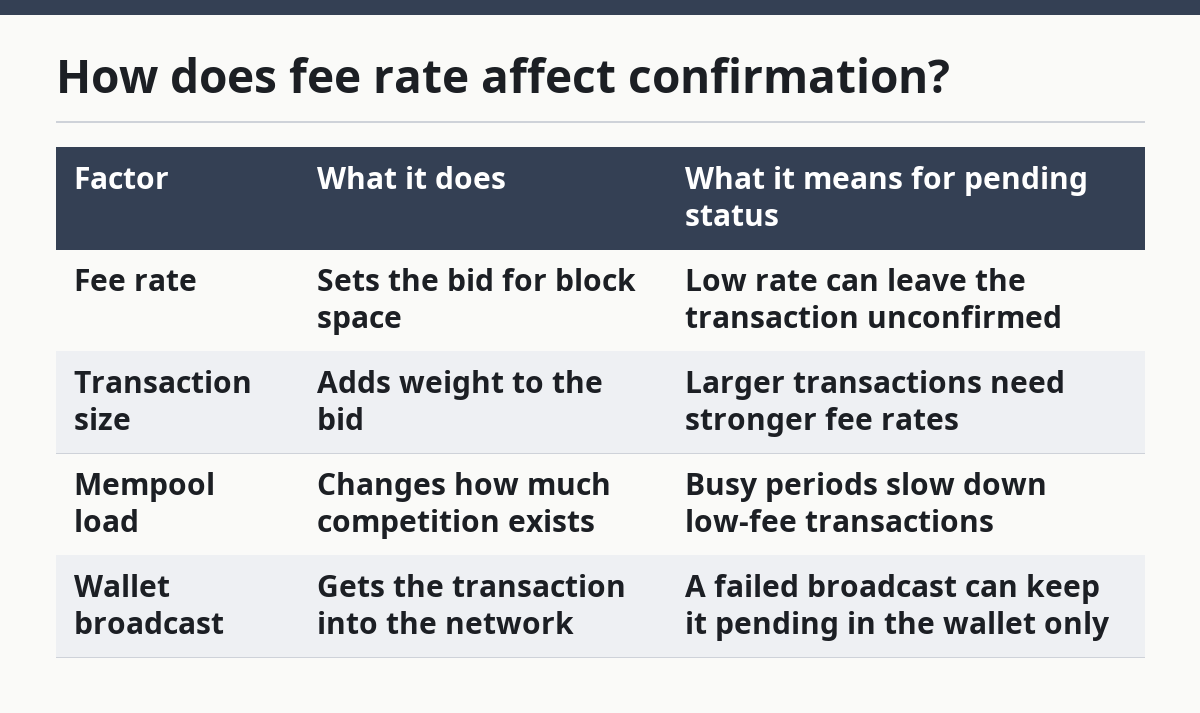
Specifically, if you are trying to understand why one transfer moved and another did not, fee rate is usually the first place to look. The fee may be perfectly valid, but not strong enough for current conditions.
Can wallet broadcast problems keep it pending?
Yes, wallet broadcast problems can keep a Bitcoin transaction pending even when the fee rate is reasonable. In that case, the wallet has not successfully pushed the transaction to enough nodes, so the network cannot confirm something it has not fully seen.
This shows up in a few ways. The wallet may say it sent the transaction, but the transaction does not appear where you expect it to. Or the wallet may keep showing a pending state because it never got a reliable acknowledgment from the network.
Broadcast issues are not the same as mining delays. A mining delay means the transaction is in the mempool and waiting its turn. A broadcast issue means the wallet’s message never properly left the local side or did not spread well enough.
This is one reason it helps to separate “pending in my wallet” from “unconfirmed on the network.” Those are related, but they are not identical. A wallet can lag, cache old data, or show a status that is more cautious than the actual network state.
If a transaction keeps saying pending after a reasonable amount of time and the fee rate looks acceptable, the broadcast path becomes more suspicious. At that point, the problem is less about the market for block space and more about whether the transaction is truly in circulation.
For more on network visibility, see /node-sync/ and /transaction-broadcast/.
When do replace-by-fee and CPFP matter?
Replace-by-fee and child pays for parent matter when the transaction is stuck and the wallet supports one of those fee-bumping paths. RBF lets a sender replace an unconfirmed transaction with a higher-fee version, while CPFP uses a follow-up transaction to pull the original one forward.
RBF is the cleaner option when it is available. It works by publishing a replacement transaction with a higher fee, which gives miners a stronger reason to include it. BIP 125 is the rule set commonly associated with this replacement behavior.
CPFP is different. It does not replace the original transaction. Instead, a new transaction spending the unconfirmed output pays enough fee to make the pair attractive together. Bitcoin Optech explains this pattern clearly in its CPFP reference.
Both tools have limits. They only help if the wallet and the transaction structure support them. If they are not available, the stuck transaction may simply need to wait until fee pressure drops or until the network clears enough space.
Because of that, it is worth checking wallet support before assuming a pending transaction is fixable by fee bumping. If your wallet does not support RBF or CPFP, the options narrow quickly.
What mistakes make the delay worse?
The most common mistake is treating every pending transaction as a cancellation or recovery problem. That can waste time and create duplicate attempts that do not solve the real issue. If the fee rate is low, the first fix is usually to work with the same transaction, not to keep sending new ones.
Another mistake is checking the wrong number. A total fee can look high while the fee rate is still weak because the transaction is large. That happens often with transactions that have multiple inputs, and it can leave a sender surprised by a delay that seemed impossible from the total fee alone.
A third mistake is rushing to change settings before knowing whether the transaction was actually broadcast. If the wallet is the only place showing the transaction, the issue may be local, although a professional review may be appropriate if you are unsure. A replacement fee or CPFP attempt will not help if the transaction never reached the network in the first place.
The practical fix is to sort the problem into one of three buckets: low fee rate, broadcast problem, or unsupported replacement path. That classification saves time and avoids paying more just to repeat the same delay.
How do I decide whether to wait or stop?
You should wait if the transaction is visible to the network, the fee rate is not far below current conditions, and the wallet does not offer a useful replacement option. In that case, a pending state often reflects normal competition for block space rather than a broken transfer.
You should stop and investigate the wallet path if the transaction remains pending in the wallet only, never seems to spread, or behaves differently from other transfers at the same fee level. That is when broadcast failure or wallet handling becomes more likely than pure mempool congestion.
The hard line is simple: if you do not know whether the transaction was broadcast, do not assume the network is the problem. If you do not know the fee rate, do not assume the delay is random. And if your wallet supports RBF or CPFP, those are the structured tools to check before you do anything else.
For a broader look at confirmation issues, the hub on on-chain transaction troubleshooting and confirmations covers the rest of the path without mixing it into this cause-based page.
Key takeaways
- A Bitcoin transaction stays pending when it has not been confirmed into a block yet.
- The most common cause is a fee rate that is too low for current mempool conditions.
- A wallet can also show pending because broadcast did not finish cleanly.
- RBF and CPFP are the main ways to deal with a stuck unconfirmed transaction, when the wallet supports them.
- Total fee and fee rate are not the same thing, and the network cares about the rate.
How long can a bitcoin transaction stay pending?
It can stay pending for a short time or for much longer, depending on mempool congestion and the fee rate attached to the transaction. Bitcoin does not promise a fixed confirmation time, and a 10-minute block target is only a target, not a guarantee.
Can a pending bitcoin transaction be canceled?
Sometimes a pending bitcoin transaction can be canceled, but not always. Cancellation depends on how the transaction was created and whether the wallet supports replace-by-fee or another replacement path, and even then the original transaction may already be circulating.
Does a low fee always cause delays?
No, a low fee does not always cause delays, but it makes delays more likely when the mempool is busy. If block space is available and competition is light, even a modest fee can confirm quickly.
Drafted with AI; not yet reviewed by a person.