Last updated: November 19, 2026
In short: a crypto wallet address is the public string you share so someone can send cryptocurrency to you on a specific blockchain network. It is not the same thing as a seed phrase, and it is not the private key that controls the funds.
Key Takeaways
- A crypto wallet address is the public receive ID for on-chain transfers and safe sharing.
- A crypto wallet address is a public identifier that tells the network where to send a transaction.
- A crypto wallet address is the receiving side of a blockchain transfer.
- A wallet address can look very different depending on the network, and that difference matters more than most beginners expect.
A crypto wallet address is the destination label for a transfer. It usually looks like a long mix of letters and numbers, sometimes presented as a QR code, and its exact format depends on the network and coin involved. This article is information only, not financial advice; for your own situation, especially if taxes, custody, or recovery rights matter, consult a qualified adviser.
Who a crypto wallet address is for
A crypto wallet address is for anyone who needs to receive a transfer on-chain, check where funds are going, or understand what information is safe to share. It assumes you already know the basic idea that crypto moves across a blockchain network and that the same coin can exist on more than one network, such as Bitcoin, Ethereum, or a layer-2 system with its own address rules.
This is not the right topic if you are trying to recover lost funds, rebuild access to a wallet, or decide how to set one up from scratch. Those are different problems with different risks. A wallet address is public by design; the danger comes from confusing it with the private pieces that control access.
The practical question here is simple: what can you share, what must stay private, and how do you avoid sending funds to the wrong place? That matters because the address format is only one part of the transfer. The network choice, the receiving app, and the token standard all have to match. If they do not, the transfer may fail, or the funds may land somewhere you did not intend.
One reliable way to think about it is this: the address is like an account destination, while the seed phrase is closer to the master backup for access. The two are related, but they are not interchangeable. If a person asks for your address, that request is normal. If a person asks for your seed phrase, that is a red flag.
For a broader view of safe handling, the hub on crypto security and recovery covers the related topics around protection and access.
What a crypto wallet address actually is
A crypto wallet address is a public identifier that tells the network where to send a transaction. It is usually derived from a wallet’s keys, but the address itself is not the key and cannot be used on its own to move funds out.
On many networks, the address is visible as a 26- to 62-character text string, though the exact length and pattern vary by chain and address format. For example, Bitcoin commonly uses address formats such as legacy, SegWit, or Taproot, while Ethereum-style addresses are typically 42 characters long including the 0x prefix. Those are format examples, not universal rules.
The needed thing to understand is that the address points to a destination on one specific blockchain network. A Bitcoin address does not mean “all crypto.” An Ethereum address is not automatically valid for every token or every chain. Some assets can be used across multiple networks, but that only works when the sender and receiver have chosen the same network path.
A wallet address is public address information, which is why it can be shown in an app, copied as text, or encoded into a QR code. Public does not mean harmless in every context, though. If an address is reused too often, outsiders may be able to connect transfers to the same holder, so it is worth considering privacy and, if needed, consulting a professional for your situation. The Electronic Frontier Foundation’s overview of cryptocurrency privacy also notes that public blockchain data can make linkage easier over time. EFF: Cryptocurrency privacy
How a crypto wallet address works
A crypto wallet address works as the receiving side of a blockchain transfer. When someone sends funds, the transaction is broadcast to the network, validated by the chain’s rules, and then written to the ledger so the address balance changes.
The sender usually needs three things to get this right: the address, the correct network, and the correct asset. If any one of those is wrong, the transfer can be delayed, rejected, or lost to the wrong chain. That is why exchanges and wallets often show a warning before you paste an address into the send field.
The address itself does not hold money in the way a bank account holds funds. Instead, the blockchain records which address controls which outputs or balances, depending on the chain’s design. On Bitcoin, the model is based on unspent transaction outputs, often shortened to UTXOs. On account-based chains such as Ethereum, the address maps to an account balance and transaction history. The user-facing idea is the same: it is the place funds are sent.
A QR code often appears beside the text address because it reduces typing mistakes. The QR code is just a machine-readable version of the same destination. If someone scans the code, they should see the same address they would see in text form. If the code and the text do not match, that is a serious warning sign; if you are unsure, consult the wallet provider or a qualified professional before sending.
This is also why many wallets show a “receive” screen with the network name. A BTC address on the Bitcoin network is not a safe substitute for the same string pasted into a different network screen. The network label is part of the job, not decorative text. The Bitcoin developer guide also explains that address and network details matter for receiving correctly. (Source: Bitcoin Developer Guide)
What a wallet address looks like on different networks
A wallet address can look very different depending on the network, and that difference matters more than most beginners expect. A string that is valid on one chain may be meaningless on another, even when the letters and numbers seem familiar.
Bitcoin addresses may start with 1, 3, or bc1, depending on the address format in use. Ethereum addresses usually start with 0x and are 42 characters long including that prefix. Other chains use their own conventions, often with different lengths, prefixes, or checksum rules. A checksum is a built-in check that helps detect typing errors in the address string.
Some wallets also show multiple address formats for the same network. That can happen with Bitcoin because older and newer formats coexist. A generic article often ignores this and pretends there is one universal shape. There is not. The format a wallet displays depends on the chain and sometimes on the wallet software itself.
This is one reason copying an address from a random screenshot is risky. A screenshot can hide the network name, the checksum status, or whether the address is actually the one the app generated for that coin. A pasted address checked inside the wallet app is better than a text message or image, because the app can usually verify the format before a transfer goes out. Coinbase’s support pages also explain that addresses are network-specific and format-specific. (Source: Coinbase Learn)
If the format does not match the asset you are sending, stop and check the receiving network first. The problem may be the wrong chain, not the wrong address.
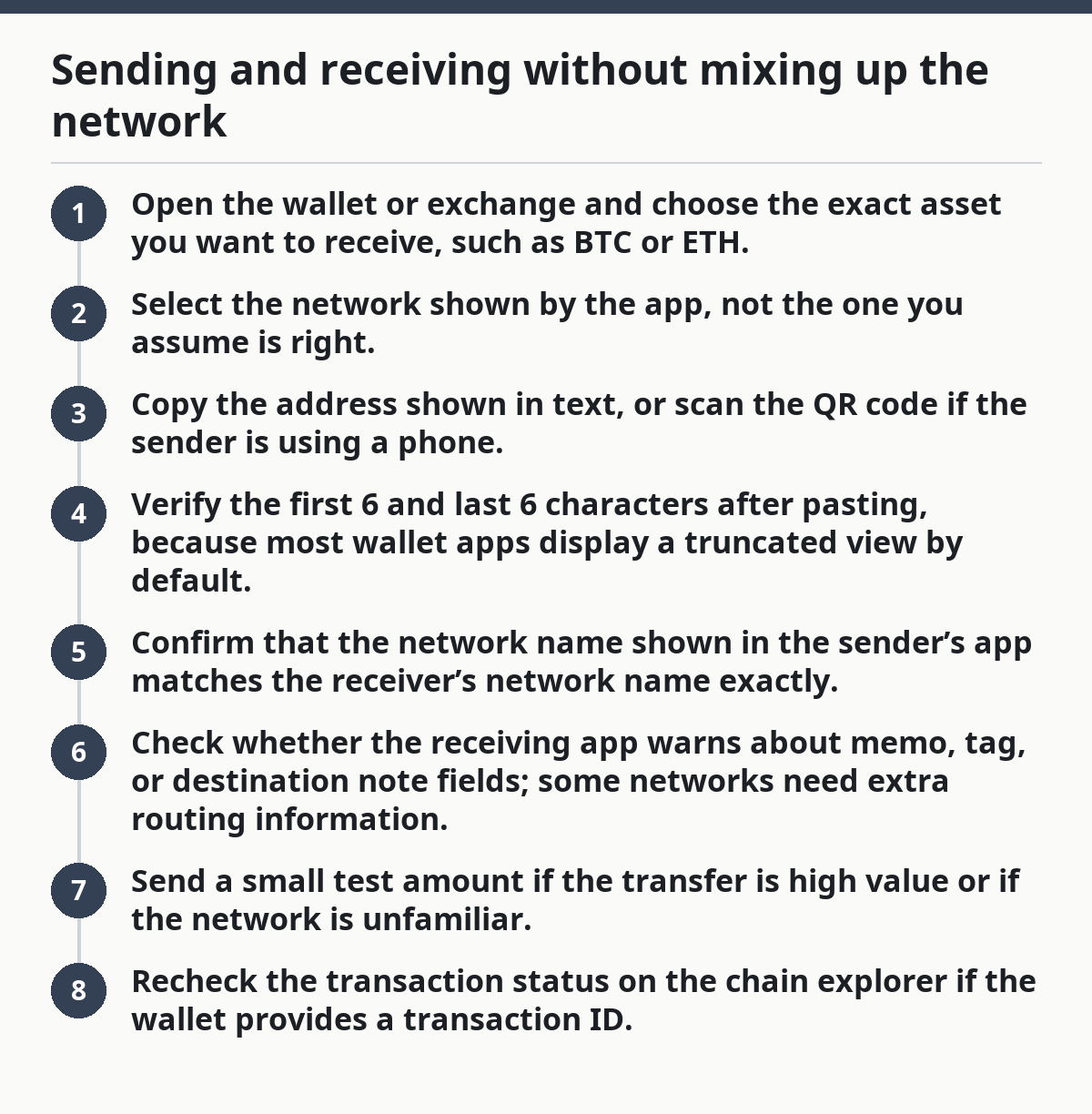
Sending and receiving without mixing up the network
A wallet address is used for both receiving and, indirectly, sending, because the same address tells the network where funds should land and where a wallet expects them to arrive. A safe rule is to treat every transfer as a two-part check: address first, network second.
To receive funds:
- Open the wallet or exchange and choose the exact asset you want to receive, such as BTC or ETH.
- Select the network shown by the app, not the one you assume is right.
- Copy the address shown in text, or scan the QR code if the sender is using a phone.
- Verify the first 6 and last 6 characters after pasting, because most wallet apps display a truncated view by default.
- Confirm that the network name shown in the sender’s app matches the receiver’s network name exactly.
- Check whether the receiving app warns about memo, tag, or destination note fields; some networks need extra routing information.
- Send a small test amount if the transfer is high value or if the network is unfamiliar.
- Recheck the transaction status on the chain explorer if the wallet provides a transaction ID.
The test transfer is not a magic fix, and I am not claiming it eliminates all risk. It is a practical check that can catch a wrong network or a copied address error before a larger amount moves. If the app throws a format warning, or the address changes after you paste it, stop and verify from the source screen again.
For sending, the steps reverse. You paste the recipient’s address, verify the network, and confirm the asset matches. If the app asks you to choose among several networks, do not guess. A transfer on the wrong network may still succeed technically while being unusable by the person who received it.
When a standard address check is not enough
A normal address check is not enough when the transfer involves a different network, a custodial platform, or an asset that uses extra routing rules. In those cases, a single copied string does not tell the whole story.
The app shows multiple networks for the same coin: that means the same token can move on more than one chain, and the wrong choice can send funds to a place the recipient cannot use — confirm the network before you send.
The receiving platform asks for a memo, tag, or destination note: that means the address alone is incomplete, and the platform may not know which account to credit without the extra field — enter the required tag exactly as shown or do not send until you understand it.
The address changes every time you open the receive screen: that is a privacy feature in some wallets, not automatically a problem — still compare the network, the asset, and the first and last characters before using it.
You are moving funds between an exchange and a self-custody wallet: that is a context where address format and network rules matter more, because the sending platform may support fewer routes than the receiving wallet — check the exchange’s withdrawal screen carefully.
The address came from chat, email, or a screenshot: that source can be edited or faked, and clipboard malware can alter pasted text — re-copy it from the wallet app or official platform screen instead of trusting the message.
The chain or token is new to you: unfamiliar formats raise the chance of a mismatch, especially when a wallet supports many assets — pause and verify the exact chain name before any transfer.
Common mistakes people make with wallet addresses
The most common mistake is sending to the right-looking address on the wrong network. The consequence is usually confusion at best and an unrecoverable transfer at worst, depending on the platforms involved. The correct alternative is to match the receiving network before you copy anything.
Another mistake is treating the QR code as a separate destination. It is only a representation of the same address, so if the code and text differ, something is wrong. If you are unsure, consult the wallet provider or a qualified professional before sending. The correct move is to trust neither until the app screen itself matches.
A third mistake is confusing a wallet address with a seed phrase. The consequence is privacy or security failure, because a seed phrase can expose control over the wallet if it is shared. The correct alternative is to share only the public address and keep the recovery material private.
A fourth mistake is copying an address from an old message thread without checking it again. Clipboard changes, network changes, and outdated receive pages all create risk. The correct alternative is to open the current receive screen and copy fresh.
A fifth mistake is assuming one address can receive every version of a token forever. Some chains and some platforms require a particular asset route or memo field. The correct alternative is to read the receiving instructions for that asset, not just the address itself.
A sixth mistake is reusing one address for every purpose without thinking about privacy. The consequence is that outside observers can connect more of your activity together on a public ledger. The correct alternative is to use the address pattern your wallet or platform provides, while understanding the privacy trade-off.
What a beginner should check before copying an address
A beginner should check the network name, the asset symbol, the address format, and any required extra field before moving a single unit of currency. That four-point check is usually enough to catch the most expensive mistakes.
First, confirm the exact asset. BTC, ETH, USDT, and other tokens may be supported on different chains, and the label alone does not tell you which network is live. Second, confirm the network name in the receive screen. Third, compare the first and last characters of the pasted address. Fourth, look for a memo, tag, or payment ID field if the platform requests one.
A good result is boring: the address pastes cleanly, the network label matches, the QR code scans to the same destination, and the sender can see the same identifier on their side. If you have to force the app, override a warning, or “make it work” by trying several chains, you are no longer doing a routine transfer.
If you want the broader safety context around access and recovery, the crypto security and recovery hub is the better place to start than guessing your way through a transfer screen.
FAQ
Is a wallet address the same as a public key?
No, a wallet address is not the same as a public key. The address is usually derived from one or more keys and is the form most people share for receiving funds. The public key may be part of the cryptographic process behind the address, but the two terms are not interchangeable.
Can I reuse the same crypto address?
Yes, you often can reuse the same address, but reuse can reduce privacy. On public blockchains, repeated use makes it easier for outside observers to link transfers together. Some wallets generate new receive addresses automatically, while others let you keep using one address if the network and app allow it.
How do I find my wallet address?
Your wallet address is usually on the app’s receive screen for the specific coin or network you chose. Open the asset, tap Receive, and copy the text address or scan the QR code shown there. If the screen offers several networks, check the one that matches the asset you plan to receive.
Drafted with AI; not yet reviewed by a person.