Last updated: November 20, 2026
A crypto transaction reorg is a blockchain reorganization: the network replaces one accepted block with another, so a transaction that looked confirmed in 1 block can move, disappear, or reappear on the new chain. This can happen when two valid blocks appear close together and the network reaches consensus on a different branch.
Key takeaways
- A reorg is not the same thing as a failed payment; it is a change in which chain the network treats as the valid one.
- A confirmation can be temporary until the chain gets deeper and the chance of reversal drops.
- An orphaned block is a block that was valid but lost the race to become part of the main chain.
- The practical risk is finality: a transaction may look settled and still change before enough later blocks build on top of it.
- This is general information, not financial advice; crypto rules and risks vary by chain, wallet, exchange, and country, so a qualified adviser should be consulted for your own situation.
A reorg matters most when a payment shows up as “confirmed” and then changes later. If a reader needs help with the broader troubleshooting flow for on-chain payments, the hub page on on-chain transaction troubleshooting and confirmations is the right next stop.
Who this applies to
This applies to anyone who sees a crypto transaction change status after it already had a confirmation, especially on chains that use probabilistic finality rather than instant finality. It assumes the reader already knows the basics of a block, a transaction, and a wallet or explorer showing confirmation status.
A reorg can affect a normal payment, an exchange deposit, or a merchant checkout. The key idea is that “confirmed” does not always mean “final” right away, and that distinction matters more on chains where consensus settles by chain weight over time rather than by a single irreversible approval.
This is not a rule to use for tax, legal, or investment decisions. Crypto rules differ by country and change often, so a qualified adviser should be consulted for the reader’s own situation.
A reader who wants a one-line definition can keep this one: a crypto transaction reorg is a consensus change that swaps one block history for another.
How does a blockchain reorganization happen?
A blockchain reorganization happens when the network switches from one valid chain tip to another because consensus favors the other branch. The transaction is not “edited” in place; instead, the chain history itself is rewritten at the tip, usually by 1 block, sometimes more.
-
A transaction is broadcast to the network. It sits in the mempool, which is the pool of unconfirmed transactions. Verify that the transaction has been seen by a block explorer or wallet; if it has not, the issue may simply be propagation, not a reorg. A problem sign is that no explorer shows it at all after several minutes or longer.
-
A miner or validator includes it in a block. That block becomes part of one chain branch. Verify that the block hash contains the transaction ID and that the wallet/explorer marks it as 1 confirmation. A problem sign is seeing the transaction in a block that is later replaced.
-
Another valid block appears close in time. Two branches now compete for network consensus. Verify that both branches follow the protocol rules; if one branch is invalid, this is not a reorg. A problem sign is a sudden split in the reported block height or chain tip.
-
Nodes choose the branch with more accumulated work or stake weight. The losing branch’s block is no longer the main chain. Verify that the wallet or explorer has switched to the longer chain. A problem sign is a transaction that was once shown as confirmed but now appears unconfirmed again.
-
The losing block becomes an orphaned block. It was valid, but it did not survive as part of the main chain. Verify whether the transaction was also included in the winning chain; if not, the transaction may have dropped back into the mempool. A problem sign is the transaction disappearing from the block where it first appeared.
-
The transaction may return to the mempool. If the winning chain did not include it, the payment can wait for another block. Verify whether the transaction still has the same fee and inputs, because double-spend conflict or fee pressure can stop it from being mined again. A problem sign is a replaced transaction or one that never reappears.
-
Later blocks rebuild confidence. Each new block makes reversal less likely. Verify the number of confirmations shown by the wallet, because one confirmation is weaker than several. A problem sign is treating a very fresh confirmation as if it were final.
-
Finality risk falls, but does not vanish in the same way on every chain. Some networks have stronger finality rules than others. Verify the chain’s consensus design before treating a confirmation as irreversible; a problem sign is assuming one chain’s behavior applies to all others.
A useful source for the original chain design is the Bitcoin whitepaper from Bitcoin.org, which explains why a chain of proof-of-work blocks can reorganize when competing branches appear.
What does “confirmation” really mean?
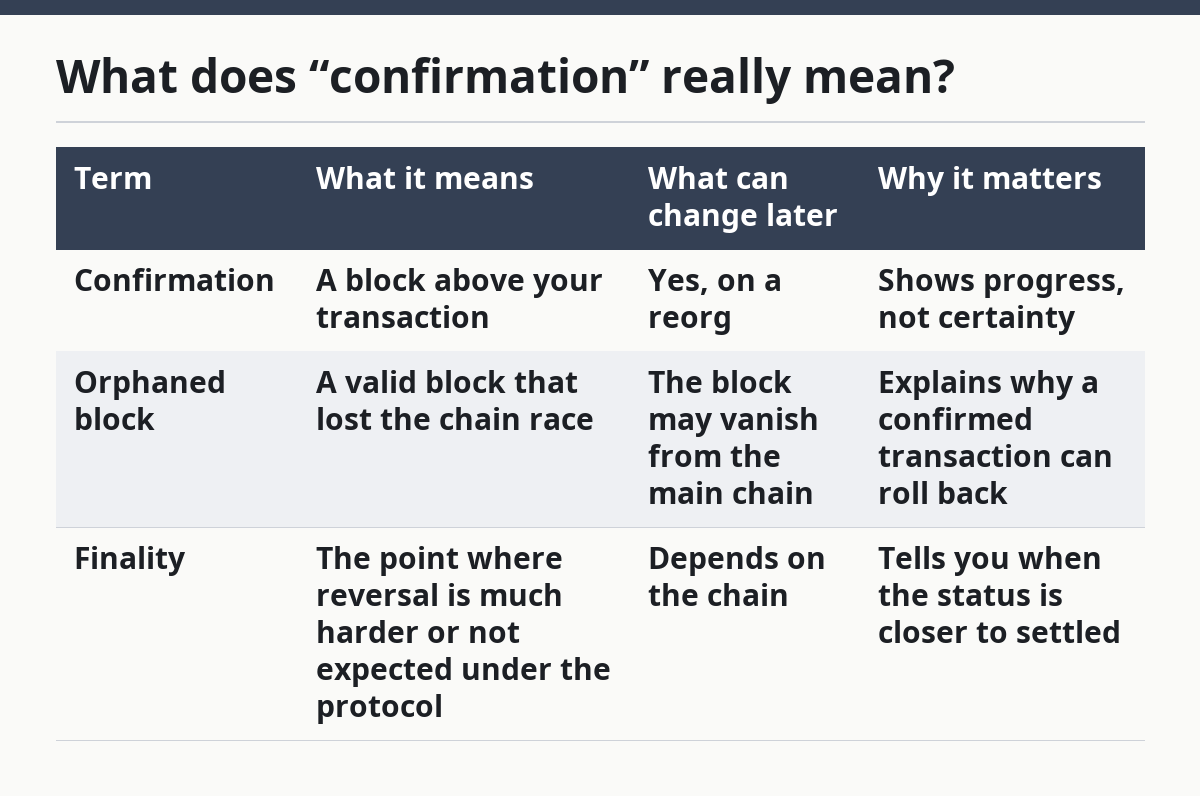
A confirmation means a block sits on top of the block containing your transaction, not that the transaction can never change. One confirmation is a signal that the network accepted the block at that moment; deeper confirmations mean the block has more later blocks protecting it.
This is why “temporary confirmations” matter. A wallet may show 1 confirmation after a few minutes, but a later reorg can turn that back into 0 if the block is removed from the main chain. On many systems, the practical risk drops as confirmations stack up, but the exact comfort level depends on the chain, the wallet, and the service receiving the funds.
The clean way to think about it is this: confirmation is a progress marker, while finality is the point where reversal becomes extremely unlikely or structurally impossible under that network’s rules. Those are not the same thing.
| Term | What it means | What can change later | Why it matters |
|---|---|---|---|
| Confirmation | A block above your transaction | Yes, on a reorg | Shows progress, not certainty |
| Orphaned block | A valid block that lost the chain race | The block may vanish from the main chain | Explains why a confirmed transaction can roll back |
| Finality | The point where reversal is much harder or not expected under the protocol | Depends on the chain | Tells you when the status is closer to settled |
For a reader who only wants the practical rule: more confirmations usually mean less reorg risk, but not all chains use the same finality model.
Why do orphaned blocks matter?
Orphaned blocks matter because they are the reason a confirmed transaction can seem to “disappear.” When a block becomes orphaned, the transactions inside it may lose their confirmation and return to an unconfirmed state if they are not included in the new main chain.
That is the core of a blockchain reorganization. The transaction itself was not necessarily bad; the chain history changed. This is why an exchange or merchant may wait for more than 1 confirmation before treating a deposit as settled, especially for larger transfers or chains known for weaker finality.
An orphaned block is also a clue that the network is doing what it is designed to do. Consensus systems expect occasional short-lived forks. The protocol resolves them by choosing one branch and dropping the other, not by preserving both forever.
The phrase to remember is “main chain,” not “first chain seen.” The first block a wallet shows is not always the one the network keeps.
When should a confirmed transaction worry you?
A confirmed transaction should worry you when the confirmation is shallow, the chain is actively splitting, or the receiver treats the payment as final too early. A deeper confirmation count reduces the chance of a reorg, but it does not remove the need to check the chain’s actual behavior.
If the transaction has only 1 confirmation: it is still early — wait for more blocks before treating it as settled. A reorg at this stage can still remove the block.
If the transaction was confirmed and then dropped back to 0: the block was likely orphaned — check whether the transaction reappeared in the mempool or a new block. If it did not, the payment may need more time or may be conflicted.
If the wallet and block explorer disagree for more than one block: one of them may be behind or on a different view of the chain — refresh both and compare the transaction hash, block height, and confirmation count.
If a merchant, exchange, or bridge credited funds before finality: the credit may be provisional — expect that service to have its own confirmation policy and reversal rules.
If the chain has a known finality model stronger than standard probabilistic proof-of-work: the advice changes — use that chain’s own settlement rules instead of a Bitcoin-style mental model.
If the transaction involved a large amount or time-sensitive settlement: the cost of a rare reorg is higher — wait longer and follow the recipient’s confirmation policy.
A general rule from Bitcoin’s network design is that waiting for more blocks lowers risk; Bitcoin’s whitepaper and later protocol discussions reflect that same basic trade-off.
What mistakes do people make?
People usually make the same 5 mistakes, and each one creates a different kind of confusion.
First, they treat “confirmed” as a final legal or financial settlement. That can lead to premature delivery of goods or services. The better alternative is to check how many confirmations the receiving service requires before crediting the deposit.
Second, they assume a block explorer error means the transaction failed. A stale explorer can simply be behind the network. The better alternative is to compare more than one explorer and the wallet’s own status.
Third, they confuse a reorg with a canceled transaction. A reorg changes chain history; it does not give the sender a wallet-level cancel button. The better alternative is to inspect whether the transaction was replaced, dropped, or re-mined.
Fourth, they ignore chain differences. A rule that is common on one network, such as waiting for several confirmations, may not match another chain’s finality model. The better alternative is to read the receiving platform’s policy for that specific chain.
Fifth, they panic after seeing an orphaned block. That can lead to duplicate sends or bad troubleshooting. The better alternative is to wait for the chain to settle, then check whether the transaction has returned with a new confirmation path.
A sixth mistake is assuming the size of the transfer changes protocol rules. The network does not care whether the transfer is 0.01 or 10 units; what changes is the human tolerance for risk.
When is the usual advice not enough?
The usual advice is not enough when the chain’s consensus model is different from the one the reader expects. Some networks have stronger settlement guarantees than proof-of-work chains with probabilistic finality, and that changes what “reorg” risk looks like.
It is also not enough when the receiving service has stricter rules than the chain itself. An exchange, merchant, or custodial wallet may require 1, 3, 6, or another number of confirmations before crediting funds. That policy is separate from the protocol, and it can be more conservative than the chain.
Another edge case is a deep reorg. These are unusual, but when they happen, more than one block can be replaced. The practical effect is bigger because more transactions lose their confirmation at once, and services may pause deposits while they verify the new chain.
A final edge case is a transaction that conflicts with another spend of the same inputs. In that case, a reorg may reveal that one version can survive and the other cannot. The network will not keep both.
For a newcomer, the safest interpretation is simple: a confirmation is a step toward settlement, not a promise that the chain cannot change.
What should you look at first if this happens?
Start with the transaction hash, the block height, and the current confirmation count. Those three items tell you whether the transaction is still in the main chain, whether it fell back to the mempool, and whether the wallet is just behind.
Then compare the wallet view with at least one public block explorer. If both show the same block height and the same number of confirmations, the status is probably current. If they disagree by 1 block or more, the wallet or explorer may be lagging, or the chain may still be settling.
The next check is the recipient’s policy. If the receiving service asked for more confirmations, the transaction may be valid but not yet usable. That is not the same thing as failure.
The best mental model is “chain history can move, and the service policy can be stricter than the chain.” Both matter.
Can a confirmed transaction disappear?
Yes, a confirmed transaction can disappear if the block that carried it becomes an orphaned block during a reorg. The transaction may return to the mempool, reappear in a later block, or remain unconfirmed until the network includes it again.
That is why a shallow confirmation is not the same as final settlement. The chance of reversal usually falls as more blocks are built on top, but the exact risk depends on the chain’s consensus model and the service receiving the funds.
How common are blockchain reorgs?
Blockchain reorgs are part of normal consensus behavior, but their size and frequency vary by chain. Short reorgs are the usual case; deeper ones are less common and more disruptive.
A reader should not assume the same risk on every network. Different chains, client software, and network conditions can change how often a reorg is seen and how many confirmations a service wants before crediting a deposit.
What should I do after a reorg?
After a reorg, check whether the transaction is back in the main chain, still in the mempool, or absent. If a wallet or service credited funds early, wait for its own confirmation policy to catch up before assuming the balance is final.
If the transaction still looks wrong after the chain settles, compare the transaction hash and block height across more than one explorer. If money is at stake and the status remains unclear, a qualified adviser should be consulted for the reader’s own situation, since the right next step can depend on the chain, the platform, and the country involved.
Drafted with AI; not yet reviewed by a person.