Last updated: November 20, 2026
Quick answer: for many users, the real cost of an exchange is often more than the headline trading fee, and a 0.1% rate can still be expensive once withdrawal fees, spreads, and limits are included. In other words, the topic of Exchange Fees, Limits, and Market Access — The Complete Guide is not just price; it is the full path from deposit to withdrawal, plus what you can actually trade. A good exchange is the one that fits your account size, your identity checks, and the markets you want, not just the one with the lowest headline fee.
If you are choosing an exchange for the first time, the three numbers that matter are not just the maker and taker fee. You also need to look at deposit and withdrawal limits, identity verification rules, and whether the venue lists the asset or market you want at all. FINRA and the SEC both warn that crypto trading brings extra risks around custody, pricing, and access controls, so the fine print matters as much as the quote on the screen. See the SEC’s investor guidance and FINRA’s crypto asset risks page for the basics.
Key takeaways
- Fees are only part of the bill; withdrawal charges, spread, and missed access can cost more than the trading fee itself.
- Limits can block a trade even when the exchange looks open, especially before identity checks are complete.
- Market access decides what you can buy, sell, or move, and that can matter more than a low fee.
- The right choice depends on account size, how often you trade, and whether you need spot, margin, or niche markets.
- A good exchange for a small beginner account can be the wrong fit for a large trader who needs higher limits and deeper books.
What do exchange fees actually include?
Exchange fees include the trading fee, but that is only the first layer. Most exchanges also charge for deposits, withdrawals, conversions, and sometimes account inactivity or network transfers.
The trading fee is usually the easiest number to see. It is often split into maker and taker rates, where makers add liquidity and takers remove it. That sounds simple until a venue uses tiered pricing, VIP levels, or volume-based discounts that change the rate after you trade more.
Therefore, the hidden cost is often the spread. If an exchange shows a tight fee but a wider bid-ask spread, the total cost of entering and leaving a position can be worse than on a venue with a slightly higher posted fee. This matters most in thin markets, where fewer buyers and sellers can move price more sharply.
Withdrawal fees can also matter a lot. Some exchanges charge a flat fee per transfer, while others pass on network costs that rise and fall with blockchain congestion. If you move funds often, a cheap trade can turn into an expensive habit.
For a beginner, a safer habit is to compare the full round trip, not just the trade ticket, and to confirm the details with the exchange’s own fee page. A low fee on paper does not help if the platform charges more to move your assets out or forces you into a poor conversion rate.
For example, if a platform advertises a 0.1% trading fee, the trade may still cost more once you add a withdrawal charge and the spread; if you are unsure how those pieces interact, check the exchange terms and ask a qualified financial professional before moving money. The SEC’s investor materials and FINRA’s guidance both stress that costs and custody risks should be understood before trading.
The best fit here is an exchange that publishes its fee schedule clearly and shows the difference between trading, funding, and withdrawal costs. It is a poor fit for anyone who only wants a single headline number and ignores the rest of the bill.
How do limits and market access change your options?
Limits and market access decide whether you can actually use an exchange the way you planned. A platform can look cheap, yet still block your order size, your deposit method, or the market pair you need.
Limits usually come in layers. There can be daily deposit caps, withdrawal caps, and trading caps tied to verification level. A basic account may let you browse the market but not move meaningful size until you complete identity checks. That is not a small detail; it can stop a time-sensitive transfer or force you to split a transaction over several days.
Meanwhile, market access is the other gate. Some exchanges list only a narrow set of major assets. Others offer spot trading, margin, derivatives, staking, or niche pairs. The wider the access, the more ways you have to trade, but the more complexity you must manage. For a quick comparison of exchange design and market structure, see also our crypto trading basics guide and how to choose a crypto exchange.
A beginner often underestimates this point. The low-fee exchange may not list the token, pair, or contract you want. In that case, the fee number does not matter because the market is missing. The reverse can also happen: an exchange with broad access may charge more, but if it is the only venue where a market exists with enough depth, the higher fee can still be the right trade.
Here is the practical rule: limits matter most when you move large sums, and market access matters most when you need a specific asset or market type. If you trade small, liquid assets, limits may be a minor annoyance. If you trade less common assets or need to move money fast, they can be the whole decision.
Low fees or higher access?
Lower fees can win for frequent, simple trades, while higher access can win for anyone who needs more than the basic market list. The better choice depends on whether your main problem is cost or capability.
| Criteria | Low-fee exchange | High-access exchange | Winner for this condition |
|---|---|---|---|
| Trading fee | Usually lower posted maker/taker rates | Often higher headline rates | Low-fee exchange if you trade often |
| Withdrawal cost | Can be low, but not always | Can be higher or less predictable | Low-fee exchange if you move funds often |
| Deposit and funding options | Often narrower | Often broader | High-access exchange if you need more payment rails |
| Verification limits | May start low and rise after checks | May offer higher tiers sooner | High-access exchange if you need larger transfers |
| Asset selection | Narrower list of majors | Broader list of pairs and products | High-access exchange if you need niche assets |
| Market depth | Strong on popular pairs only | Better chance of deeper choice across markets | High-access exchange for less common markets |
| Ease of use | Often simpler | Often more complex | Low-fee exchange for beginners |
| Risk of surprise charges | Lower if fee schedule is plain | Higher if product set is broad | Low-fee exchange for cost control |
| Fit for small trades | Usually strong | Sometimes overbuilt | Low-fee exchange for small accounts |
| Fit for advanced use | Can be too limited | Better suited | High-access exchange for advanced traders |
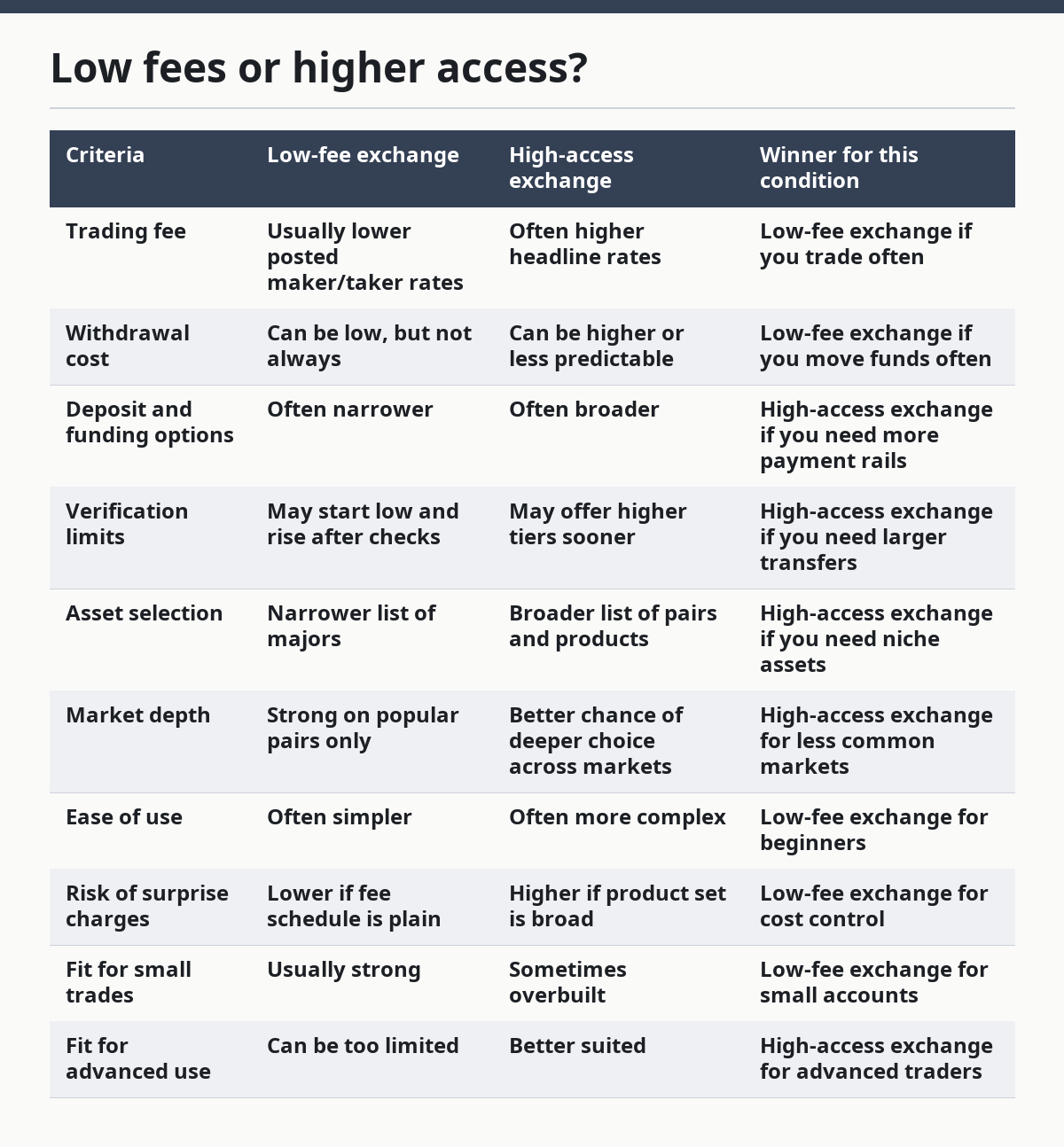
The low-fee exchange wins when the same asset is available on both venues and you do simple spot trades. It is also the cleaner choice for users who trade a few times a month and want the bill to stay easy to read.
The downside is reach. Lower-fee venues often keep their product list tight, and they may cap withdrawals or restrict access to certain markets until you complete more checks. That can be fine for a beginner. It is a problem for someone who needs size, speed, or a wider menu.
In contrast, the high-access exchange wins when you need more than the basics. That includes larger transfers, a broader list of assets, or trading products that a stripped-down venue does not offer. The trade-off is cost and complexity. The fee schedule may be harder to read, and the platform may expect you to know what maker, taker, spread, and liquidation risk mean before you place a trade.
A clear example: if your goal is to buy one liquid asset and hold it, the lower-fee route usually makes more sense. If your goal is to trade multiple pairs, move higher amounts, or use markets that are not widely listed, access should outrank the lowest fee.
What matters most for beginners?
For beginners, limits and plain pricing matter more than the smallest possible fee. A simple fee schedule with known withdrawal caps is usually better than a complex menu of discounts you may never use.
A beginner account often runs into two walls first: verification and withdrawal limits. Verification can take time, and the platform may hold funds or restrict movement until the process is complete. Withdrawal caps can also make a small test deposit easy but a full transfer awkward.
Therefore, a beginner should look for three things before anything else. First, the exchange should show the full fee schedule without hiding the basic numbers in fine print. Second, it should explain what level of verification opens higher limits. Third, it should state which markets are actually available at the account level you expect to use.
The beginner mistake is chasing the lowest trading fee and ignoring the rest of the bill. A platform with a 0.1% trading fee sounds appealing until you discover the withdrawal fee, the conversion spread, or the limit that prevents a planned transfer. If the numbers are unclear, check the exchange’s own disclosures and seek professional advice before acting. A slightly higher fee with clearer rules can be the cheaper path in real life.
This route is not for people who need advanced products or large transfers right away. It is for smaller accounts, first-time users, and anyone who values clarity over range.
Where do advanced traders get burned?
Advanced traders get burned when limits, depth, and product access do not match the size or speed of their plan. At that level, the cheapest fee is often a false win if the platform cannot support the trade flow.
A large trader cares about order-book depth, not just the posted rate. A market with a low fee but thin liquidity can produce slippage that costs more than the fee savings. That is especially true when a large order hits a market that cannot absorb it cleanly.
A trader who expects to move size should also look at market depth in the actual pair, not just the exchange brand. One major market can be deep, while another on the same venue is shallow.
Advanced users also run into product gaps. A venue may support spot trading but not the margin or derivatives product a trader expects. It may list the asset, but not the exact pair needed for an efficient route. That forces extra conversion steps, and each step adds cost and timing risk.
Limits become more visible at larger size. A withdrawal cap that feels harmless on a small account can become a blocker when a trader needs to move funds between venues or off-platform. Verification tiers matter too, because higher limits often depend on identity checks or extra review.
The better fit for advanced use is the exchange that shows depth, product range, and limits in plain view. The weaker fit is the venue that advertises a low rate but buries the practical constraints. A professional trader can work around a small fee difference; a blocked market or capped transfer is harder to solve.
When do the rules flip?
The overall choice flips when one of four things matters more than the fee. In those cases, market access or limits beat a cheap rate every time.
First, the fee no longer matters if the exchange does not list the asset or market you need. If the venue is missing the pair, the cheapest price is still useless.
Second, the rule flips when you need a larger transfer than the account tier allows. A basic account with low limits may be fine for small trades but wrong for a real transfer schedule.
Third, the fee is not the main issue when depth is thin. A small posted fee can hide a much worse execution price if the order book is shallow.
Fourth, the choice changes when you need specific product types. Spot-only access is not enough for someone who needs margin, derivatives, or a wider range of market pairs.
That is why a one-line “best exchange” answer fails. The right venue depends on what part of the process you cannot afford to fail: cost, size, or access.
How should you compare exchanges before opening an account?
Compare exchanges by the full path from deposit to withdrawal, not by one fee on a pricing page. That is the only way to see whether the venue fits your real use case.
Start with the fee schedule. Look for maker, taker, conversion, and withdrawal costs, not just the headline rate. Then check whether the exchange explains limits by verification level, because that decides what you can do before and after you complete KYC.
Next, check market access. See whether the exchange lists the asset, pair, or product you actually want. If you need only one major asset, a narrow platform may be fine. If you need more than that, the broader venue may justify a higher fee. You can also compare broader exchange rules in our verification and limits overview.
After that, look at how the exchange handles movement off-platform. A low trading fee is not enough if the withdrawal process is expensive or slow. The exchange should make those rules easy to find before you commit funds.
Two useful public sources on risk and access are the SEC’s investor material on crypto asset investing and FINRA’s guidance on crypto asset risks. They are not a substitute for checking the exchange’s own terms, but they are a good reminder that pricing, custody, and market access all carry trade-offs.
What should you choose?
Choose the low-fee exchange if you trade simple markets, move modest amounts, and want a clear bill. Choose the high-access exchange if you need larger limits, broader asset support, or more advanced products. Neither if you need full certainty on pricing, limits, and market access before you commit funds.
That is the cleanest call. The low-fee route fits beginners and light users who value simplicity. The broader-access route fits active users and larger accounts that would be blocked by tight limits or a thin product list.
The wrong choice is the one that only looks cheap. An exchange with a lower posted fee can still cost more if it limits withdrawals, hides conversion costs, or does not list the market you need. A more expensive platform can be the better choice if it removes those problems.
For a reader who just wants the shortest answer: start with the exchange that can actually support your trade, then compare the fee. Do not do it the other way around.
What if I only care about the cheapest fee?
The cheapest fee is only the right answer if the exchange also supports the asset, the limit, and the withdrawal path you need. A low posted rate can still lose once you factor in spread and transfer costs.
That is why “cheapest” is a weak way to choose a financial platform. You may save a little on the trade and lose more on the exit. The better question is whether the full round trip is cheaper, not just the first click.
Do limits matter for small accounts?
Yes, because a small account can still get blocked by verification or withdrawal rules. A low deposit amount does not remove the need to understand the account tier.
For small users, the main risk is friction, not size. The exchange may let you open the account quickly but still hold back features until identity checks are done. That is why limits should be read before the first deposit, not after.
Is broader market access always better?
No, because broader access usually comes with more complexity and a harder fee structure. More products can mean more ways to make a mistake.
Broad access is useful when you need niche assets, more pairs, or advanced trading types. It is not useful if you only want a few liquid markets and a simple fee schedule. In that case, the extra range can just add noise.
Which matters most: fee, limit, or access?
Access matters first if the asset or market is missing, limits matter first if your transfer is blocked, and fee matters first if both of those are already fine. That order keeps the choice practical.
If all three are acceptable, then fee becomes the tie-breaker. If one of them fails, the lowest fee does not rescue the exchange.
Drafted with AI; not yet reviewed by a person.