
Last updated: November 19, 2026
Quick Answer: slippage is the difference between the price you expect and the price you actually get on a trade. In What Is Slippage in Crypto Trading?, that gap can be tiny or large, depending on liquidity, volatility, and order size. It happens when the market moves, the order book is thin, or your order is large enough to move the price. This article explains what slippage means in crypto trading, where it shows up, and what people often confuse it with.
What slippage means in crypto trading
Slippage is the difference between the price you saw when you clicked trade and the price your order finally filled at. In crypto, that gap can be tiny or ugly, depending on liquidity, volatility, and the type of market order you use.
For example, a trade on Bitcoin at $60,000 can still fill above or below that quote if the market shifts before execution. That is what makes slippage in crypto trading a live execution issue, not just a chart concept.
Picture this: you’re on a crypto exchange, the quote says one price, and your order hits a moving market a second later. That small delay is enough to change the fill. The result can be better than expected, worse than expected, or exactly the same.
- Positive slippage: you get a better price than expected.
- Negative slippage: you get a worse price than expected.
- No slippage: your fill matches the quoted price.
Slippage is not a fee line on the receipt. It is a market effect. On a busy coin pair with deep liquidity, it may be hard to notice. On a thin pair, a sudden move can make it obvious in seconds.
Key Takeaways
- Slippage is the gap between expected and executed price.
- It shows up most in fast, thin, or jumpy markets.
- A market order is a common trigger, though not the only one.
- Spread, liquidity, and speed all shape the final fill.
- Slippage can help or hurt, but it is not a fee.
How slippage happens on a crypto exchange
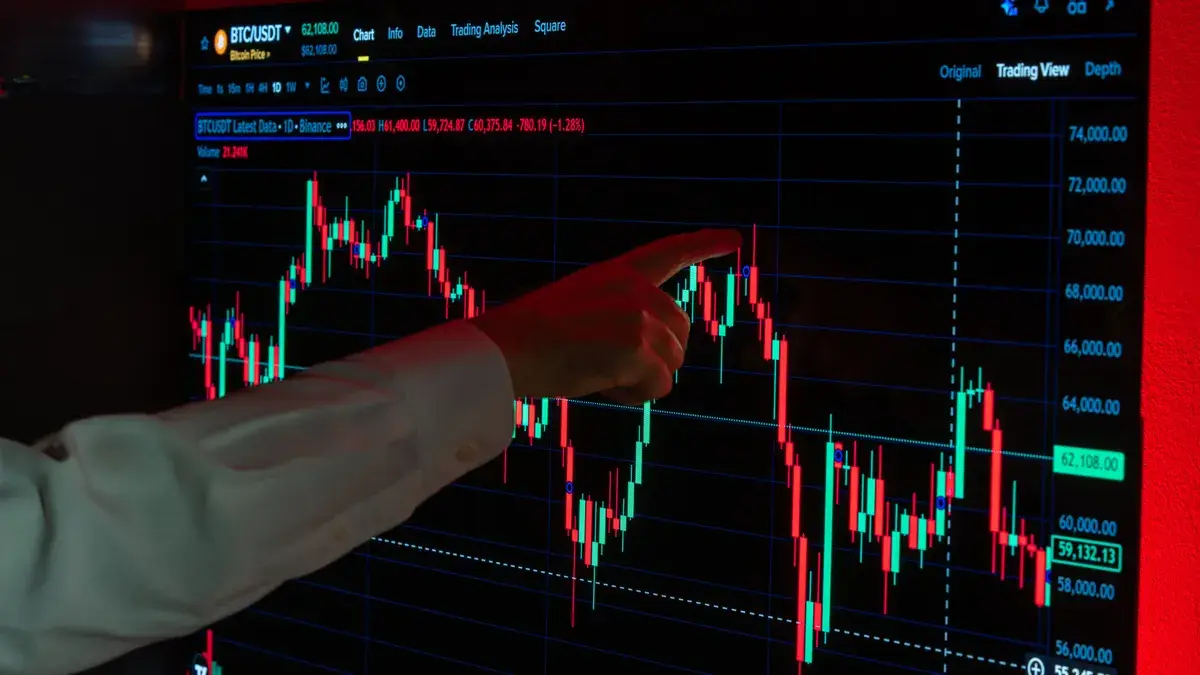
Picture this: you place a trade on a crypto exchange and the best available price disappears before your order reaches the book. The exchange then fills you at the next available price levels, which may be higher or lower than the quote you saw.
A market order asks the exchange to execute immediately at the best available prices. That sounds simple. The catch is that “best available” may be a stack of different prices across the order book, not one neat number. If enough volume is waiting, you get close to the quote. If not, your order eats through several levels.
Here’s the catch: the bigger your order, the more likely it is to move the price itself. That is called price impact. It matters because your trade is no longer just reacting to the market — it is changing the market a little.
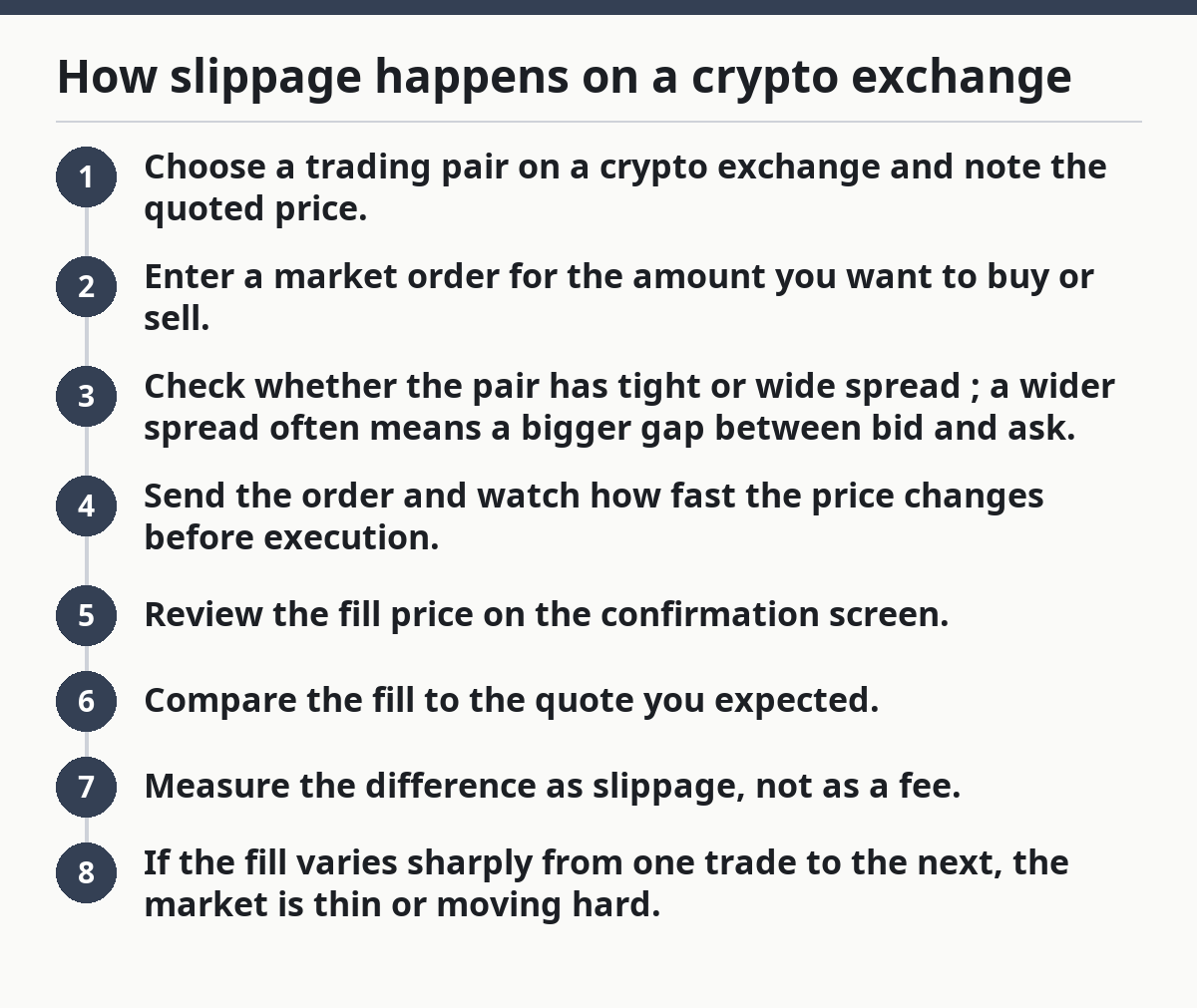
- Choose a trading pair on a crypto exchange and note the quoted price.
- Enter a market order for the amount you want to buy or sell.
- Check whether the pair has tight or wide spread; a wider spread often means a bigger gap between bid and ask.
- Send the order and watch how fast the price changes before execution.
- Review the fill price on the confirmation screen.
- Compare the fill to the quote you expected.
- Measure the difference as slippage, not as a fee.
- If the fill varies sharply from one trade to the next, the market is thin or moving hard.
A problem shows up when the fill price keeps drifting away from the quote as your order size rises. That is a sign the market is shallow, not that the exchange necessarily made a mistake.
Why does slippage happen?
Slippage happens because crypto prices can change between the moment you decide to trade and the moment the order is filled. That gap widens when liquidity is thin, when volatility jumps, or when the spread is already wide.
Picture this: you’re trading during a news spike, a token listing, or a sharp market drop. Prices can move several ticks in seconds, and your order may land after the move has started. In that setting, the quote on screen is only a snapshot.
For instance, on a major pair the fill may stay close to the quote, while on a thin token the gap can widen quickly. The difference is often visible in the order book itself.
The three main drivers are simple:
- Low liquidity: not enough resting orders to absorb your trade at one price.
- High volatility: rapid price movement between submission and fill.
- Wide spread: a larger gap between the highest bid and lowest ask.
On the flip side, a major pair with heavy volume and calm trading often shows little slippage. That does not make the trade risk-free. It just means the market has enough depth to absorb your order more cleanly.
A common mistake is blaming slippage on the exchange alone. Sometimes the exchange route, fees, and order handling matter. But in many cases, the market itself is the main cause.
- Thin pairs are more fragile.
- Fast markets can move before execution.
- Large orders can push through multiple price levels.
- A wide spread can make the starting quote misleading.
How is slippage different from fees and spread?
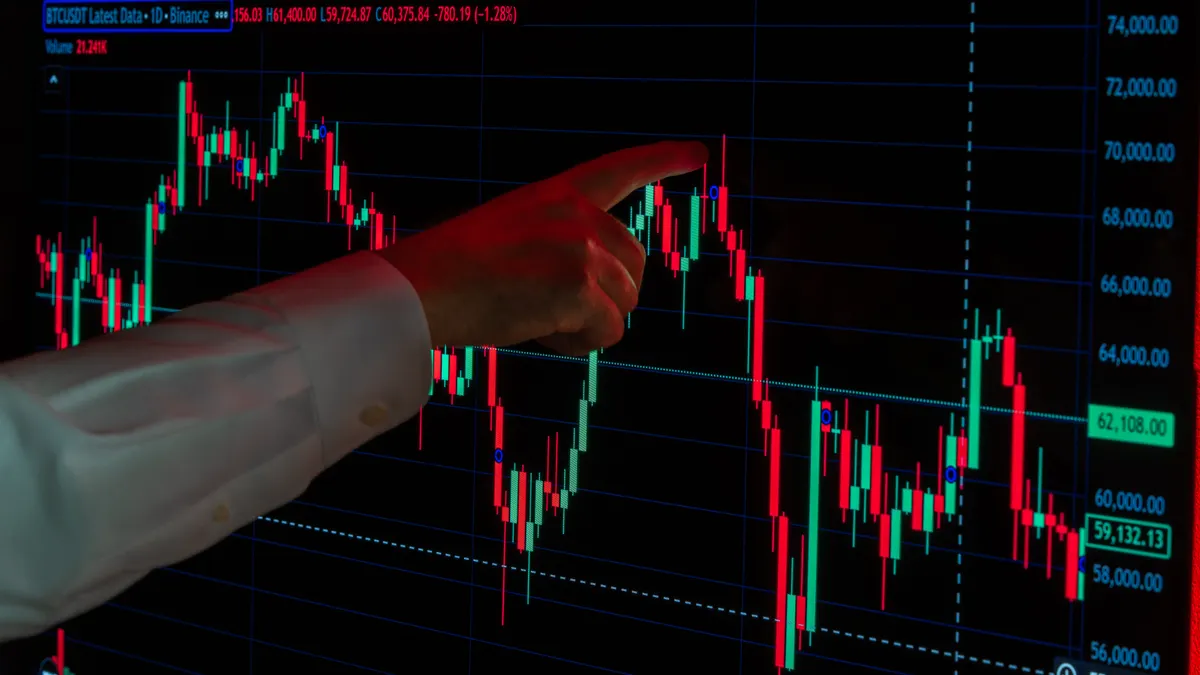
Slippage is different from fees because fees are charged by the exchange, while slippage comes from the price moving between quote and execution. The spread is also not the same thing: it is the gap between the bid and ask price before you trade.
Picture this: you see one ask price, then your order fills above it. The spread explains the market’s starting gap. The fee explains what the exchange charged. Slippage explains the extra difference that appeared during execution.
That distinction matters because a trade can look expensive for two separate reasons. First, the spread may already be wide. Second, the execution may slip further. If you only check the fee line, you miss the real cost of the trade.
A simple way to separate them:
- Fee: visible charge from the exchange.
- Spread: built into the quoted market prices.
- Slippage: execution moved away from the quote.
Slippage is often confused with bad pricing, but the market can move against you even when the exchange does exactly what you asked. It can also move in your favor, which is why slippage is not always a loss.
What makes slippage worse?
Picture this: you’re trading a small-cap token at a busy moment and the quote looks fine for a second. Then a burst of orders hits the market, the spread opens, and your fill lands far from the screen price. That is the kind of setup that can create severe slippage.
Several conditions make the gap larger:
- Low volume: fewer orders to absorb yours.
- Large order size: you consume more of the order book.
- Fast price swings: the market moves before execution.
- Low-quality routing: the order may reach a worse pool of liquidity.
- Illiquid trading hours: fewer participants are active.
The same trade can behave very differently on two assets with the same headline price. A large-cap coin with deep markets may fill cleanly. A thin token may not. Price level alone does not tell you much.
A specific warning sign is a trade that moves the quote itself before it fully fills. That is price impact at work. It is more likely when the order is large relative to the available depth. The result can be a fill that is materially worse than expected.
What can a trader do about slippage?
Picture this: you want to trade on a crypto exchange, but you do not want a rushed fill to chase a bad price. The practical answer is to reduce the conditions that create slippage, then check the fill before you treat the trade as settled.
Because this is information rather than financial advice, and because exchange rules, market conditions, and local regulations differ by country and change often, a qualified adviser should be consulted for your own situation. For general market structure, the U.S. Securities and Exchange Commission’s investor guidance on order types and the BIS discussion of market liquidity are useful starting points. SEC, BIS
- Trade when liquidity is deeper — Choose pairs and times with more activity, and verify that the spread is narrow before sending the order. A widening spread is a warning sign.
- Keep order size modest — Break large trades into smaller pieces if the market is shallow. If the fill worsens as size rises, the book is thin.
- Watch volatility — Avoid sending a market order into a fast move unless you accept a wide range of possible fills. A calm chart does not guarantee calm execution.
- Check the quote and the fill — Compare the screen price with the final execution price. If the gap is large, the market moved or the order was too aggressive.
- Use trading tools carefully — Some platforms let you set execution constraints or route orders differently. Read the exchange’s own terms before relying on any feature.
- Do not confuse speed with certainty — Fast execution can still fill at a bad price if the market is moving hard.
- Review recurring patterns — If a pair always slips badly, the issue may be the asset, not the platform.
A good result is not “zero slippage.” A good result is a fill that matches the market conditions you could reasonably expect. If the price gap is repeatedly large, the trade setup is the wrong one for that asset.
When is slippage a sign to stop trading?
Slippage is a sign to stop when the market conditions no longer match the trade you intended. In that case, the problem is not your math — it is the market structure in front of you.
Picture this: the quote jumps between the time you click and the time the order is ready, and the spread is already wide. That combination means the price you thought you were getting may no longer exist.
The spread is wide and moving: the market has opened up, so your expected fill is stale — pause and wait for calmer conditions.
The pair has very low liquidity: there may not be enough resting orders to absorb your trade — choose a smaller size or skip the pair.
Your order size is large relative to the market: you may be moving the price yourself — reduce size or split the order.
The market is in a fast news move: execution can lag the quote by a lot — accept that the fill may be poor or stand aside.
The same trade slips badly every time: the asset or venue may not suit your method — use a more liquid pair or a different trading setup.
On a high-stakes subject like money, the wrong move is to ignore repeated slippage and call it normal. If the market keeps pushing your fill far from the quote, the setup is telling you something.
What people confuse slippage with
Picture this: you open the trade ticket, see a rough gap, and assume the exchange is charging extra. That is a common mistake. The fill can be worse because of market movement, not because of a hidden fee.
The most common mix-ups are these:
- Slippage vs. fee: the fee is explicit; slippage comes from execution.
- Slippage vs. spread: the spread exists before you trade; slippage appears during the fill.
- Slippage vs. bad quote display: the screen price may lag a fast market.
- Slippage vs. price impact: price impact is one reason slippage gets worse on larger orders.
A trader who understands those differences can read a fill report more clearly. A trader who does not may blame the wrong part of the process and miss the real problem.
For deeper mechanics around how exchanges match trades, the main hub on crypto trading and exchange mechanics fits this topic without repeating it here.
Why does slippage happen?
Slippage happens because the market can move between the time you submit an order and the time the exchange fills it. It gets worse when liquidity is thin, volatility is high, or your order is large enough to push through multiple price levels.
How can I reduce slippage?
You can reduce slippage by trading in more liquid pairs, avoiding fast market spikes, and keeping order size small relative to available depth. You can also check the spread before you trade and compare the fill price with the quote right after execution.
Is slippage the same as fees?
No. Slippage is a change in execution price, while fees are charges from the exchange. A trade can have both, and they should be checked separately so you know what part of the cost came from the market and what part came from the platform.
Drafted with AI; not yet reviewed by a person.